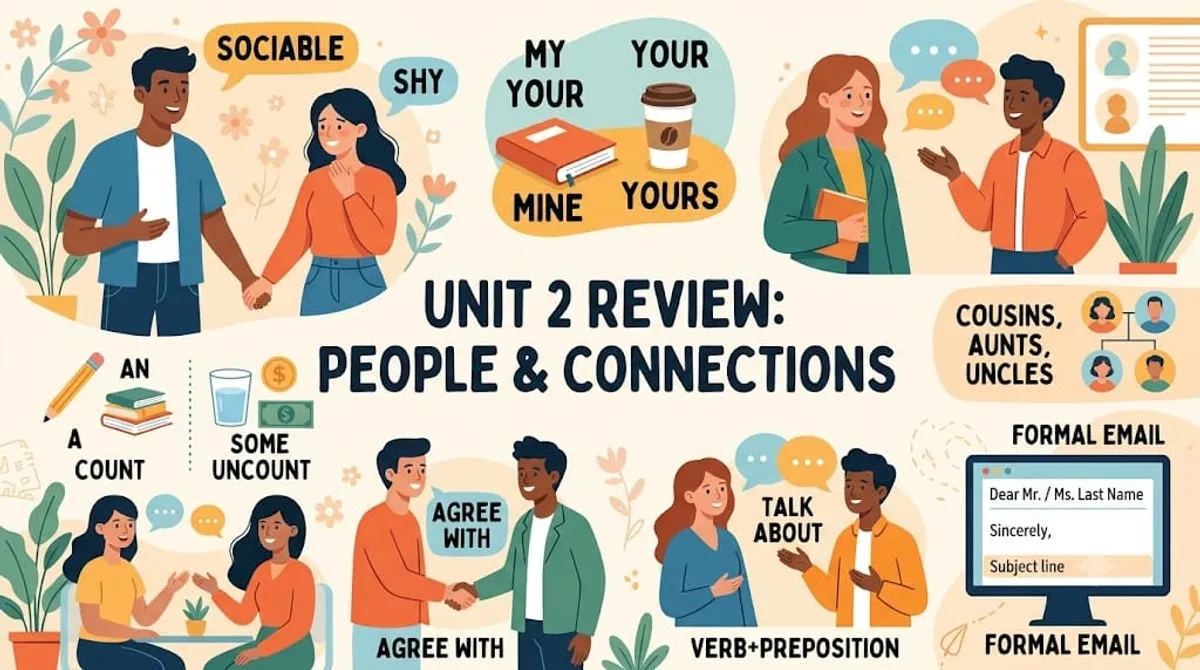
Today, we are reviewing everything from Unit 2 to get you ready for our latest classroom challenge. Before you jump into the game to test your skills, you may want to read the refresher below the game.
[
{
"title": "Unit 2 Comprehensive Review",
"hint": {
"summary": "Unit 2 Grammar & Vocabulary Essentials",
"content": "**Possessive Adjectives** (*my, your*) come before nouns; **Possessive Pronouns** (*mine, yours*) replace nouns.\n**Verb + Preposition**: Memorize fixed pairs like *agree with*, *wait for*, and *talk about*.\n**Count vs. Uncount**: Use *a/an* for singular count nouns and *some/a lot of* for uncount nouns or plurals.\n**Emails**: Use *Dear Sir/Madam* and *Sincerely* for formal contexts."
},
"questions": [
{
"type": "multiple-choice",
"question": "My sister loves meeting new people and going to parties. She is very ___.",
"options": ["sociable", "shy", "curly"],
"correctIndex": 0,
"explanation": "A **sociable** person is friendly and enjoys spending time with others."
},
{
"type": "multiple-choice",
"question": "He works in the same office as me. He is my ___.",
"options": ["colleague", "classmate", "neighbor"],
"correctIndex": 0,
"explanation": "A **colleague** is someone you work with at a job."
},
{
"type": "multiple-choice",
"question": "Is this backpack ___? I found it under your desk.",
"options": ["yours", "your", "you"],
"correctIndex": 0,
"explanation": "Use the possessive pronoun **yours** because there is no noun after it."
},
{
"type": "multiple-choice",
"question": "I don't think you are right. I completely disagree ___ you.",
"options": ["with", "to", "about"],
"correctIndex": 0,
"explanation": "We use the fixed prepositional phrase **agree/disagree with** someone."
},
{
"type": "multiple-choice",
"question": "Could you please ask ___ some help? I cannot lift this heavy box.",
"options": ["for", "to", "with"],
"correctIndex": 0,
"explanation": "The phrase **ask for** means to request something."
},
{
"type": "multiple-choice",
"question": "Would you like ___ apple or some orange juice?",
"options": ["an", "a", "some"],
"correctIndex": 0,
"explanation": "Use **an** before singular countable nouns that start with a vowel sound."
},
{
"type": "multiple-choice",
"question": "We need to buy ___ furniture for our new living room.",
"options": ["some", "a", "many"],
"correctIndex": 0,
"explanation": "'Furniture' is an **uncountable noun**, so we use **some**."
},
{
"type": "multiple-choice",
"question": "Which of these is the most appropriate closing for a formal business email?",
"options": ["Sincerely,", "Bye for now,", "See ya later,"],
"correctIndex": 0,
"explanation": "**Sincerely** is standard and appropriate for formal business emails."
},
{
"type": "multiple-choice",
"question": "My mother's sister is my ___.",
"options": ["aunty", "niece", "uncle"],
"correctIndex": 0,
"explanation": "Your mother or father's sister is your **aunty** (or aunt)."
},
{
"type": "multiple-choice",
"question": "Unlike Thai family labels, English family labels focus much more heavily on ___.",
"options": ["gender", "age", "status"],
"correctIndex": 0,
"explanation": "English labels emphasize **gender** (e.g., uncle/aunty, niece/nephew) over relative seniority or age."
},
{
"type": "fill-in-the-blank",
"instruction": "Fill in the blank with the correct adjective or noun:",
"question": "She doesn't like talking in front of crowds because she is very ___.",
"answer": ["shy"],
"explanation": "Someone who is nervous or uncomfortable around other people is **shy**."
},
{
"type": "fill-in-the-blank",
"instruction": "Fill in the blank with the correct vocabulary word:",
"question": "The person who lives right next door to your house is your ___.",
"answer": ["neighbor", "neighbour"],
"explanation": "A **neighbor** is a person who lives near or next to you."
},
{
"type": "fill-in-the-blank",
"instruction": "Fill in the blank with a possessive word:",
"question": "That is my book. It belongs to me. It is ___.",
"answer": ["mine"],
"explanation": "**Mine** is the possessive pronoun that means 'my book'."
},
{
"type": "fill-in-the-blank",
"instruction": "Fill in the blank with a possessive word:",
"question": "Sara lost her keys yesterday. Have you seen ___ keys anywhere?",
"answer": ["her"],
"explanation": "Use the possessive adjective **her** before the noun 'keys'."
},
{
"type": "fill-in-the-blank",
"instruction": "Fill in the blank with the correct preposition:",
"question": "What are you two arguing about? Let's talk ___ the problem calmly.",
"answer": ["about"],
"explanation": "We say **talk about** a topic or problem."
},
{
"type": "fill-in-the-blank",
"instruction": "Fill in the blank with the correct preposition:",
"question": "Please don't leave! Can you wait ___ me for five minutes?",
"answer": ["for"],
"explanation": "The verb **wait** is followed by the preposition **for** when mentioning a person or object."
},
{
"type": "fill-in-the-blank",
"instruction": "Fill in the blank with the correct plural form:",
"question": "There are three ___ (child) playing outside in the garden.",
"answer": ["children"],
"explanation": "'Child' has an irregular plural form: **children**."
},
{
"type": "fill-in-the-blank",
"instruction": "Fill in the blank with a formal greeting term:",
"question": "___ Sir or Madam, I am writing to inquire about the job opening.",
"answer": ["Dear"],
"explanation": "**Dear** is the formal greeting standard for professional correspondence."
},
{
"type": "fill-in-the-blank",
"instruction": "Fill in the blank with the correct family term:",
"question": "My brother's son is my ___.",
"answer": ["nephew"],
"explanation": "A son of your brother or sister is your **nephew**."
},
{
"type": "fill-in-the-blank",
"instruction": "Fill in the blank with the correct prepositional verb structure:",
"question": "He loves sports. He is very good ___ basketball.",
"answer": ["at"],
"explanation": "The idiom is **good at** + noun/gerund."
},
{
"type": "scramble",
"sentence": "She has beautiful curly hair.",
"explanation": "Opinion/Evaluation comes before physical characteristics: *beautiful* + *curly* + *hair*."
},
{
"type": "scramble",
"sentence": "We communicate online every evening.",
"explanation": "Subject + verb + prepositional object + time expression."
},
{
"type": "scramble",
"sentence": "I take care of my grandmother.",
"explanation": "Subject + verb + phrasal verb phrase + object."
},
{
"type": "scramble",
"sentence": "Is this beautiful house theirs?",
"explanation": ""
},
{
"type": "scramble",
"sentence": "I love to spend time with my close friends.",
"explanation": "The standard phrasal sequence is **spend time with** + people."
},
{
"type": "scramble",
"sentence": "We are working on a school project.",
"explanation": "Present continuous structure: **working on** + noun phrase."
},
{
"type": "scramble",
"sentence": "There is a lot of traffic on the road today.",
"explanation": "'Traffic' is an uncountable noun phrase introduced by *There is a lot of*."
},
{
"type": "scramble",
"sentence": "Please include a clear subject line.",
"explanation": ""
},
{
"type": "scramble",
"sentence": "My grandparents have five young grandchildren.",
"explanation": "Subject (grandparents) + verb (have) + adjective (young) + object noun (grandchildren)."
},
{
"type": "scramble",
"sentence": "He is a complete stranger.",
"explanation": ""
}
]
}
]
👥 1. Vocabulary Masterlist
Character, Appearance, & Abilities
- Personality: How do we describe who someone is? If a person is friendly and enjoys being around others, they are sociable (รักการเข้าสังคม). On the opposite side, if they feel nervous or quiet around new people, they are shy (ขี้อาย).
- Physical Descriptions: When describing hair, we use terms like straight (ผมตรง), wavy (ผมลอน), or curly (ผมหยิก).
- Abilities: To talk about a talent or skill, use the phrase is good at (เก่งในด้าน...) followed by a noun or a verb ending in -ing (e.g., "He is good at drawing").
Social Circles & Connections
- Classmate: Someone who studies in the same room or school as you. (เพื่อนร่วมชั้นเรียน)
- Colleague: A person you work with at a job or office. (เพื่อนร่วมงาน)
- Neighbor: Someone who lives right next door to or near your house. (เพื่อนบ้าน)
- Close friend: A person you know very well, trust deeply, and love spending time with. (เพื่อนสนิท)
- Online friend: A friend you met on the internet and primarily talk to through screens. (เพื่อนในอินเทอร์เน็ต)
- Opposite: Something or someone that is completely different from another (e.g., Hot is the opposite of cold; shy is the opposite of sociable). (สิ่งตรงกันข้าม)
Interacting With Others
- Communicate: To share information, speak, or write to others (e.g., "We communicate by phone"). (สื่อสาร)
- Take care of: To look after someone or something and keep them safe (e.g., "I take care of my cat" or "She takes care of her younger brother"). (ดูแล)
🏠 2. Family Terms: English vs. Thai Labels
One major difference between English and Thai culture is how we label family members.
- Thai Labels: Often focus heavily on age and seniority (ภาษาไทยจะแยกคำเรียกตามอายุที่แก่กว่าหรืออ่อนกว่าพ่อแม่ เช่น ลุง/น้า ป้า/อา).
- English Labels: Focus much more on gender (เพศ) than age.
- Grandparents / Grandchildren: Your parents' parents are grandparents (ปู่ย่าตายาย); you are their grandchild (หลาน - ลูกของลูก).
- Aunts & Uncles: Your mother or father's sister is always your text 表达 aunt (ป้า/น้าสาว/อาผู้หญิง), and their brother is always your uncle (ลุง/น้าชาย/อาผู้ชาย)—regardless of age.
- Cousins: The children of your aunts and uncles are your cousins (ลูกพี่ลูกน้อง).
- Nieces & Nephews: Your brother or sister’s son is your nephew (หลานชาย - ลูกของพี่น้อง), and their daughter is your niece (หลานสาว - ลูกของพี่น้อง).
- Immediate Family: Your parents' male child is your brother (พี่ชาย/น้องชาย), and the female child is your sister (พี่สาว/น้องสาว). To your parents, you are either a son (ลูกชาย) or a daughter (ลูกสาว).
🎒 3. Grammar Component
Possessive Adjectives vs. Possessive Pronouns
Don't mix up your possessives! The golden rule depends on whether a noun follows the word.
- Possessive Adjectives (my, your, his, her, its, our, their)
- Rule: They MUST come right before a noun.
- Thai Note: ใช้แสดงความเป็นเจ้าของโดยต้องมีคำนามตามหลังเสมอ
- Example: "This is my jacket." (นี่คือเสื้อแจ็คเก็ตของฉัน)
- Possessive Pronouns (mine, yours, his, hers, ours, theirs)
- Rule: They REPLACE the noun entirely. They stand completely alone.
- Thai Note: ใช้แทนคำนามกลุ่มนั้นไปเลยเพื่อลดความซ้ำซ้อน ห้ามมีคำนามตามหลังเด็ดขาด
- Example: "This jacket is mine." (เสื้อแจ็คเก็ตตัวนี้เป็นของฉัน)
Verb + Preposition Pairs (คำกริยา + บุพบทคู่ใจ)
In English, certain verbs are happily married to specific prepositions. You must memorize these exact pairs:
- Agree with: "I agree with my teammate." (เห็นด้วยกับ)
- Talk to / Talk about: "I need to talk to the teacher about my grade." (คุยกับ / คุยเกี่ยวกับ)
- Ask for: "If you are lost, ask for directions." (ขอ)
- Wait for: "Please wait for me at the bus stop." (รอ)
- Spend time with: "I love to spend time with my family." (ใช้เวลากับ)
- Work on: "We are working on a difficult history project." (ทำงานเกี่ยวกับ/ปรับปรุง)
- Write to: "She writes a letter to her pen pal every month." (เขียนจดหมายหา)
Count and Uncount Nouns (คำนามนับได้และนับไม่ได้)
- Making Plurals: Countable nouns can be made plural by adding -s/-es (book $\rightarrow$ books) or changing irregularly (child $\rightarrow$ children). Uncountable nouns cannot be made plural (traffic, furniture, advice). (คำนามนับไม่ได้ห้ามเติม s เสมอ)
- A / An: Use only with singular, countable nouns (a neighbor, an apple). (ใช้กับนามนับได้ที่เป็นเอกพจน์หรือมีสิ่งเดียว)
- Some / A lot of: Use these with uncountable nouns or plural countable nouns (some water, a lot of friends). (ใช้กับนามนับไม่ได้หรือนามพหูพจน์)
📬 4. Reading & Writing Skills
Identifying Audience and Purpose (ผู้ฟังและวัตถุประสงค์)
Whenever you read a text or a message, always ask yourself two questions:
- Who is the Audience? Who was this written for? (e.g., students, parents, customers, a close friend). (ข้อความนี้เขียนให้ใครอ่าน?)
- What is the Purpose? Why did the author write this? To inform, to invite, to complain, or to apologize? (ผู้เขียนเขียนขึ้นมาเพื่อวัตถุประสงค์อะไร?)
When communicating professionally via email, casual slang won't work. Use this exact template:
- Subject Line: A brief, clear summary of what the email is about. (ชื่อเรื่อง: สรุปสั้นๆ)
- Opening Greeting: Use Dear Mr. / Ms. [Last Name] or Dear Sir / Madam (if you don't know their name). (คำขึ้นต้นแบบทางการ)
- Closing Sign-off: End the email formally using Sincerely or Best Regards, followed by your full name. (คำลงท้ายแบบทางการ)
🎮 Ready to Play?