
Practicing People and Possessives
An A2-B1 English reading worksheet focused on relationship vocabulary and possessive adjectives through a short narrative about friends, neighbors, and colleagues.
Title
Practicing People and PossessivesSeo_intro
An A2-B1 English reading worksheet focused on relationship vocabulary and possessive adjectives through a short narrative about friends, neighbors, and colleagues.
Reading Text
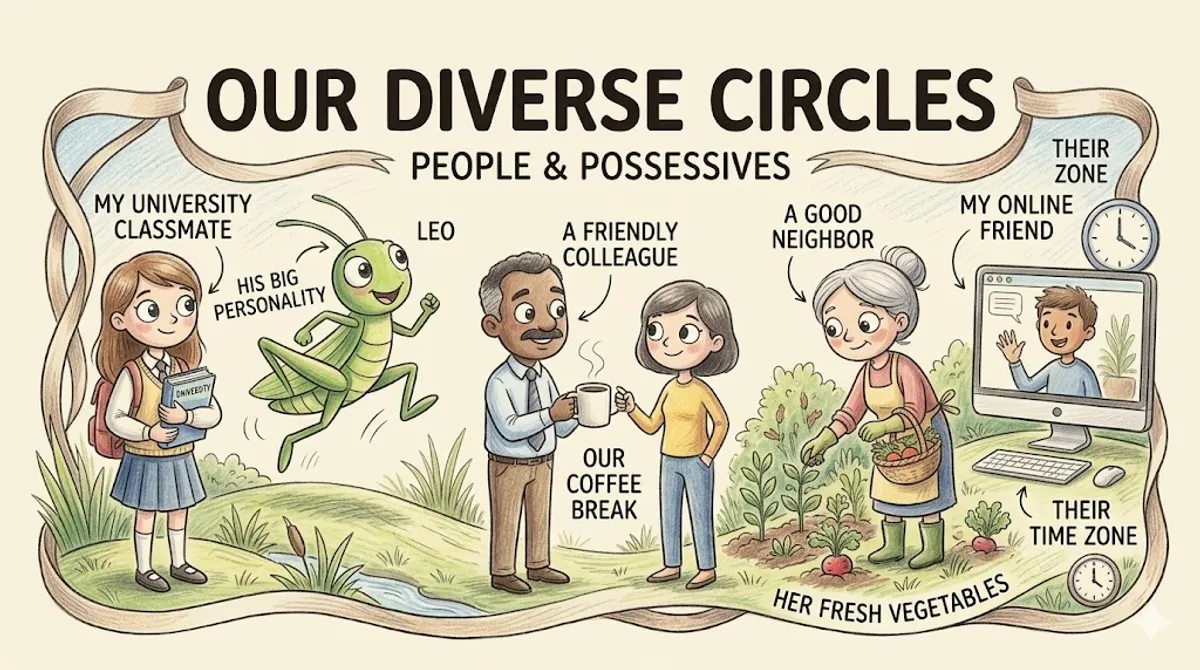
Meet my social circle! First, there is Sarah. She is my classmate at university, and we always study together for our exams. In contrast, Leo is the complete opposite of Sarah; she is quiet, but his personality is very loud and energetic. Despite this, he is my close friend because we share the same hobbies. At work, I see Mr. Davis. He is a friendly colleague who always shares his morning coffee with me. Then there is Mrs. Higgins, our good neighbor. Her garden is beautiful, and she often brings us fresh vegetables from it. Finally, I talk to Ken every evening. He is an online friend from Japan. Their time zone is very different from mine, but we still chat daily. All these people make my life interesting, and I appreciate their unique roles in my daily routine.
Activities
Vocabulary
- Label: classmateAnswer: DEF_1
- Label: oppositeAnswer: DEF_2
- Label: close friendAnswer: DEF_3
- Label: friendly colleagueAnswer: DEF_4
- Label: good neighborAnswer: DEF_5
- Label: online friendAnswer: DEF_6
- Text: A person who is in the same class as you at a school or university.
- Text: A person or thing that is totally different from someone or something else.
- Text: A person who you know very well, trust, and like a lot.
- Text: A kind, pleasant person that you work with.
- Text: A helpful and kind person living near or next door to you.
- Text: A person you know and communicate with primarily over the internet.
- Before: I need to ask aAfter: for the homework assignment because I missed yesterday's class.Answer: classmate
- Before: She lives next door and is aAfter: who always helps water my plants when I am on vacation.Answer: good neighbor
- Before: We have never met in person, but myAfter: sends me interesting messages from Japan every day.Answer: online friend
- Before: John is aAfter: because he always helps me fix computer issues at the office.Answer: friendly colleague
- Before: I tell all my secrets to Sarah because she is a trusted andAfter: of mine.Answer: close friend
Comprehension
- Text: Sarah and the writer study together for their university exams.Answer: true
- Text: Leo and Sarah have the exact same quiet personality.Answer: false
- Text: Mr. Davis shares his morning coffee with the writer at work.Answer: true
- Text: Mrs. Higgins brings fresh flowers from her garden to the writer.Answer: false
- Text: Ken and the writer chat daily despite being in different time zones.Answer: true
- Text: friend / close / is / Leo / my / ThisAnswer: This is my close friend Leo.
- Text: together / exams / our / study / We / forAnswer: We study for our exams together.
- Text: very / beautiful / garden / Her / isAnswer: Her garden is very beautiful.
- Text: with / coffee / his / shares / me / HeAnswer: He shares his coffee with me.
- Text: unique / roles / appreciate / their / IAnswer: I appreciate their unique roles.
Written Expression
- Text:
Write about a classmate or a friendly colleague. Make sure to use at least 3 possessive adjectives like 'his', 'her', or 'our'.
Example 1: My classmate is named Alex. His favorite subject is math, and we always complete our group projects together.
Critical Thinking
Discuss with a partner why it is valuable to have a diverse social circle containing different types of relationships (e.g., neighbors vs. online friends). What unique support does each type offer?
Think about someone in your life who is the complete opposite of you. How do your differences affect your communication, and what can you learn from their perspective?
Recommended for You

Visakha Bucha Day in Thailand
A B1-level reading worksheet for middle school students exploring the traditions, family rituals, and cultural significa...
Staying Connected: Friends and Family
Practice reading comprehension and vocabulary at an A2-B1 level with a text about friendship, family, and modern communi...
Regrets and Alternates: Navigating Past Imagined Situations
Master the third conditional and expressions of past regret with this intermediate English worksheet focusing on 'if I h...