Subject vs Object Questions
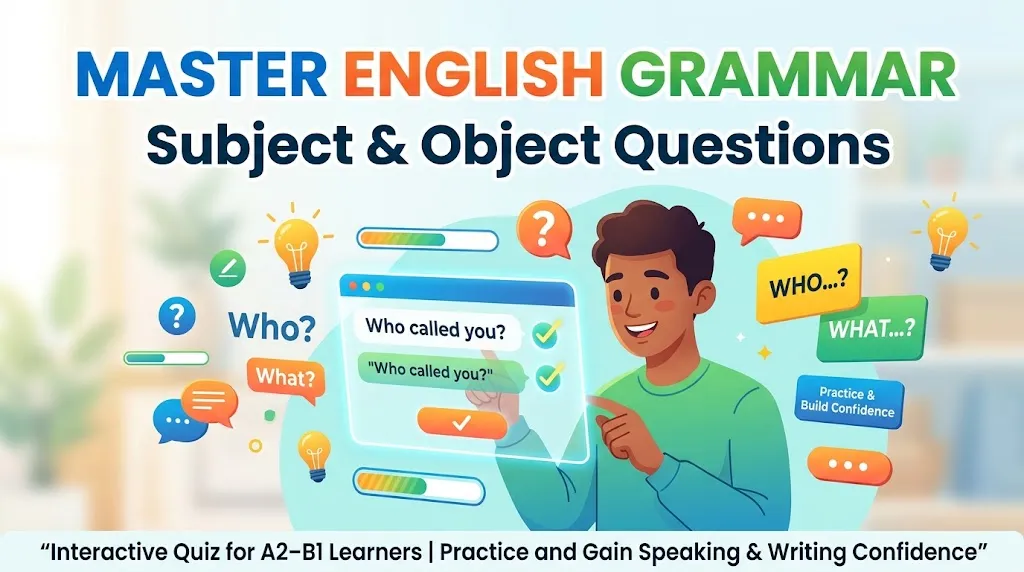
Master English grammar with this interactive quiz designed for A2–B1 learners. Practice distinguishing subject and object questions through multiple-choice, fill-in-the-blank, and sentence-building challenges to build speaking and writing confidence.
Subject vs Object Questions
Master English grammar with this interactive quiz designed for A2–B1 learners. Practice distinguishing subject and object questions through multiple-choice, fill-in-the-blank, and sentence-building challenges to build speaking and writing confidence.
When forming questions in English, the word order changes depending on whether you are asking about the subject (the person or thing doing the action) or the object (the person or thing receiving the action).
-
Subject Questions: When the question word (Who, What, Which) is the subject of the sentence, do not use auxiliary verbs (do / does / did). The verb follows normal affirmative sentence order.
-
Example: Who called you? (Someone called you.)
-
-
Object Questions: When the question word asks about the object, use the auxiliary verb (do / does / did) before the subject.
-
Example: Who did you call? (You called someone.)
-
คำอธิบายภาษาไทย (Thai Explanation)
-
Subject Questions (คำถามหาประธาน): ใช้ถามว่า "ใคร" หรือ "อะไร" เป็นผู้กระทำ ไม่ต้องใส่กริยาช่วย (do / does / did) ให้ตามด้วยคำกริยาแท้ได้เลย เช่น Who broke the window? (ใครทำหน้าต่างแตก?)
-
Object Questions (คำถามหากรรม): ใช้ถามว่าประธานกระทำกับ "ใคร" หรือ "อะไร" ต้องมีกริยาช่วย (do / does / did) วางไว้หน้าประธานเสมอ เช่น Who did you meet yesterday? (เมื่อวานคุณไปเจอใครมา?)
Practice distinguishing between subject and object questions with this interactive grammar challenge. Complete multiple-choice options, fill in missing auxiliary or main verbs, and un-scramble complete sentences to master question structures.
- Title: Subject vs Object Questions
Hint
Summary: Subject vs Object QuestionsContent:* **Subject Questions:** Ask about the person/thing doing the action. Do **not** use auxiliary verbs like *do/does/did*. (e.g., *Who called you?*) * **Object Questions:** Ask about the person/thing receiving the action. Use auxiliary verbs like *do/does/did*. (e.g., *Who did you call?*)
Questions:- Question: ___ broke the window?Options:
- Who
- Who did
- Who was
Explanation: This is a **subject question** (asking who did the action), so do not use *did*. - Question: What ___ at the supermarket yesterday?Options:
- did you buy
- you bought
- bought you
Explanation: This is an **object question**, so use the auxiliary verb *did* + base verb. - Question: Who ___ next door to you?Options:
- lives
- does live
- do live
Explanation:**Subject question:** The question word *Who* acts as the subject, so use the normal verb form *lives*.
- Question: Which movie ___ to watch tonight?Options:
- do you want
- want you
- you want
Explanation: **Object question:** Use the auxiliary *do* + subject *you* + verb *want*. - Question: What ___ to your car?Options:
- happened
- did happen
- did it happen
Explanation: **Subject question:** *What* is the subject that caused the action, so no auxiliary *did* is needed. - Question: Who ___ you invite to your birthday party?Options:
- did
- was
- does
Explanation:**Object question:** *You* are the subject inviting someone, so use the auxiliary *did* for past tense.
- Question: Who ___ this delicious cake?Options:
- baked
- did bake
- bakes did
Explanation: **Subject question:** *Who* performed the action of baking, so use past simple *baked* directly. - Question: Where ___ your keys?Options:
- did you leave
- you left
- left you
Explanation: **Object question:** Asking for the location/object requires the auxiliary *did*. - Question: Which team ___ the championship last year?Options:
- won
- did win
- does win
Explanation: **Subject question:** *Which team* is the subject that won the match. - Question: Who ___ you talk to on the phone?Options:
- did
- was
- has
Explanation: **Object question:** The person is the object of the preposition *to*, requiring auxiliary *did*. - Instruction: Complete the subject question:Question: Who ___ (call) you late last night?Answer:
- called
Explanation: Use past simple **called** without an auxiliary verb because *Who* is the subject. - Instruction: Complete the object question:Question: Who ___ you meet at the cafe yesterday?Answer:
- did
Explanation: Use auxiliary **did** for past tense object questions with the subject *you*. - Instruction: Complete the subject question:Question: What ___ (make) that strange noise just now?Answer:
- made
Explanation: **Subject question:** *What* is the subject, so use past tense **made** directly. - Instruction: Complete the object question:Question: What ___ they want for dinner?Answer:
- do
Explanation: Use present auxiliary **do** for object questions with the subject *they*. - Instruction: Complete the subject question:Question: Who ___ (teach) English at your school?Answer:
- teaches
Explanation: **Subject question:** In present simple, use 3rd person singular **teaches** with *Who*. - Instruction: Complete the object question:Question: Which song ___ she like best?Answer:
- does
Explanation: Use auxiliary **does** for 3rd person singular subject (*she*) in an object question. - Instruction: Complete the subject question:Question: Who ___ (write) this famous novel?Answer:
- wrote
Explanation: **Subject question:** *Who* performed the action, so use the past form **wrote**. - Instruction: Complete the object question:Question: What ___ you do last weekend?Answer:
- did
Explanation: Use past auxiliary **did** for object questions. - Instruction: Complete the subject question:Question: Which bus ___ (go) to the train station?Answer:
- goes
Explanation: **Subject question:** *Which bus* is the subject, so use the present simple verb **goes**. - Instruction: Complete the object question:Question: Where ___ he live during the summer?Answer:
- does
Explanation: Use auxiliary **does** for the third-person subject *he* in object questions. - Sentence: Who won the competition?Explanation: **Subject question:** Who + past verb + object/prepositional phrase.
- Sentence: Who did you see at the party yesterday?Explanation: **Object question:** Who + did + subject + verb + place/time.
- Sentence: What happened to your computer this morning?Explanation: **Subject question:** What + past verb + prepositional phrase.
- Sentence: What did you buy at the shopping mall?Explanation: **Object question:** What + did + subject + base verb + place.
- Sentence: Which car belongs to our teacher?Explanation: **Subject question:** Which car + verb + prepositional phrase.
- Sentence: Which shirt do you prefer to wear?Explanation: **Object question:** Which shirt + do + subject + verb + infinitive.
- Sentence: Who called you on the phone this morning?Explanation: **Subject question:** Who + past verb + object + time phrase.
- Sentence: Who do you usually study with after class?Explanation: **Object question:** Who + do + subject + adverb + verb + preposition + time.
- Sentence: What caused the delay at the airport?Explanation: **Subject question:** What + past verb + object + place.
- Sentence: Where does your brother work every day?Explanation: **Object question:** Where + does + subject + base verb + time.
Recommended for You

Question Tags - Level 2
Practice making natural conversation in English by adding mini-questions to the end of your sentences.

Avoiding Repetition with Auxiliaries
Linkers - Speed Run
Linkers (linking words or conjunctions) help show the relationship between two sentences or clauses—whether you want to ...