The Origin of 'Carbon Footprint'
Explore how the concept of the carbon footprint was created and why focusing on individual guilt affects working communities.
The Origin of 'Carbon Footprint'
Explore how the concept of the carbon footprint was created and why focusing on individual guilt affects working communities.
Title
The Origin of 'Carbon Footprint'Seo_intro
Explore how the concept of the carbon footprint was created and why focusing on individual guilt affects working communities.
Parts
- Part_number: 1Text:
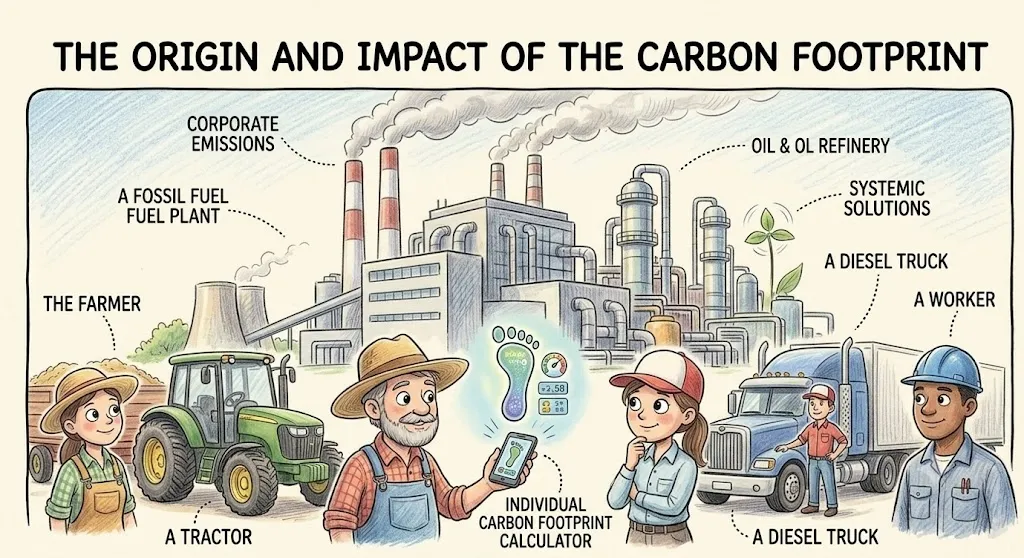
When discussing climate change, people often talk about their carbon footprint—the amount of greenhouse gas their daily activities produce. However, many people do not realize where this concept came from. In 2004, the major oil company British Petroleum (BP), alongside an advertising agency, promoted the idea of an individual carbon footprint calculator. Their goal was to shift public attention away from fossil fuel corporations and make regular citizens feel responsible for global warming through their everyday choices, like driving, eating meat, or flying. This clever strategy redirected systemic blame onto individual consumers.
Vocabulary_explanations
Carbon footprint: The total amount of greenhouse gases produced by human activities.Greenhouse gas: Gases in Earth's atmosphere that trap heat.Major: Very large, important, or serious.Advertising agency: A company that creates marketing campaigns for businesses.Promoted: Encouraged the popularity or development of something.Shift: To move or change position, direction, or focus.Fossil fuel: Fuels such as coal or oil formed from living organisms.Regular citizens: Ordinary people who do not hold special power.Redirected: Sent something in a different direction.Systemic: Relating to or affecting an entire system rather than individual parts.Questions:- Question: Which company helped popularize the carbon footprint calculator in 2004?Options:
- A) An electric car manufacturer
- B) British Petroleum (BP)
- C) An environmental non-profit
Answer: B) British Petroleum (BP) - Question: The main goal of the carbon footprint campaign was to focus attention on major corporations.Options:
- True
- False
Answer: False - Question: What everyday choices were mentioned as examples of personal emissions?Options:
- A) Driving, eating meat, or flying
- B) Recycling, planting trees, or walking
- C) Solar power, farming, or fishing
Answer: A) Driving, eating meat, or flying
- Part_number: 2Text:
Focusing on personal guilt did more than just distract the public from corporate actions. It actively pushed working-class communities—such as farmers, truck drivers, and industrial workers—toward climate science denial. When workers who rely on diesel-powered vehicles or heavy machinery are told that their carbon footprint makes them responsible for climate change, they feel personally blamed. Many of these workers do not have affordable, electric alternatives to earn a living. Being told their daily work is damaging the planet creates guilt and defensiveness. To protect their jobs and livelihoods, it becomes much easier for them to believe messages that minimize climate science.
Vocabulary_explanations
Guilt: A feeling of having done something wrong.Working-class: Socioeconomic group consisting of people employed in manual or industrial work.Industrial: Relating to large-scale manufacturing or industry.Denial: Refusal to accept the truth or reality of something.Rely on: To depend on someone or something.Machinery: Large, complex machines used in work.Affordable: Inexpensive enough for average people to pay for.Livelihoods: The means of securing the necessities of life, like work or income.Defensiveness: The quality of being anxious to protect oneself from criticism.Minimize: To represent something as reduced or small in importance.Questions:- Question: How did personal guilt affect many working-class communities?Options:
- A) It inspired them to buy electric trucks
- B) It pushed them toward climate science denial
- C) It caused them to change careers immediately
Answer: B) It pushed them toward climate science denial - Question: Workers who use heavy machinery often have cheap, easy electric alternatives available.Options:
- True
- False
Answer: False - Question: Why do some workers adopt defensive attitudes toward environmental messages?Options:
- A) They want to protect their jobs and livelihoods
- B) They dislike advertising agencies
- C) They prefer driving smaller vehicles
Answer: A) They want to protect their jobs and livelihoods
- Part_number: 3Text:
Fossil fuel companies used a dual strategy to protect their business. Publicly, they promoted individual carbon footprints to frame climate change as a personal moral issue rather than a corporate one. Behind the scenes, they funded campaigns to spread doubt about climate science. When working-class people felt judged by environmental activists, climate science denial offered a way to defend themselves against personal guilt. Furthermore, treating environmentalism as a test of personal choices—like buying an expensive electric car or eating a strict vegan diet—makes the movement seem out of reach for many rural and working-class families.
Vocabulary_explanations
Dual strategy: A plan that involves two distinct parts or approaches.Moral: Relating to principles of right and wrong behavior.Behind the scenes: Secretly or away from public view.Funded: Provided money for a specific cause or project.Doubt: A feeling of uncertainty or lack of conviction.Judged: Formed an opinion or criticism about someone.Activists: People who campaign for political or social change.Strict: Demanding that rules or conditions are obeyed exactly.Out of reach: Not accessible or attainable for someone.Rural: Relating to the countryside rather than the town.Questions:- Question: What did fossil fuel companies do behind the scenes?Options:
- A) Built solar farms
- B) Funded campaigns to spread doubt about climate science
- C) Reduced oil prices for farmers
Answer: B) Funded campaigns to spread doubt about climate science - Question:
Framing climate action around expensive personal choices can make the movement feel inaccessible to some families.
Options:- True
- False
Answer: True - Question: According to the text, what did climate denial offer to workers who felt judged?Options:
- A) A way to defend themselves against personal guilt
- B) A financial subsidy for electric cars
- C) A practical solution to energy costs
Answer: A) A way to defend themselves against personal guilt
- Part_number: 4Text:
The reality is that transport, farming, and energy systems were built around fossil fuels long before individual consumers had a choice. Shaming workers for using the only available tools turns a structural problem into a cultural argument. Focusing on individual guilt divides communities and makes it harder to fight climate change. Instead of blaming consumers and workers, meaningful progress requires systemic solutions—such as building renewable energy grids, providing affordable green technology, and holding fossil fuel corporations accountable for their impact.
Vocabulary_explanations
Shaming: Making someone feel ashamed or embarrassed.Available: Able to be used, obtained, or reached.Structural: Relating to the basic system or framework of something.Divides: Causes disagreement or separation among people.Meaningful: Having real importance, value, or purpose.Progress: Movement toward a refined, improved, or desired state.Renewable energy: Energy from a source that is not depleted when used.Grids: Networks of lines or cables for distributing power.Holding accountable: Requiring a person or organization to take responsibility for actions.Impact: The strong effect or influence of something.Questions:- Question: When were energy and transport systems built around fossil fuels?Options:
- A) Long before individual consumers had a choice
- B) Just a few years ago
- C) Right after the invention of the electric car
Answer: A) Long before individual consumers had a choice - Question: Shaming workers helps bring communities together to solve climate problems.Options:
- True
- False
Answer: False - Question: Which of the following is listed as a systemic solution?Options:
- A) Encouraging individual guilt
- B) Building renewable energy grids
- C) Ignoring corporate responsibility
Answer: B) Building renewable energy grids
Critical Thinking
Title: Critical Thinking & DiscussionInstructions:How might climate action campaigns change their message so that working-class individuals feel supported rather than blamed?
In what ways can governments balance holding large corporations accountable while still encouraging individual environmental responsibility?
References
Recommended for You

Smart Study Secrets: Easy Ways to Ace Your Tests
Discover easy, science-backed study tips for middle schoolers to improve memory, prepare for exams, and study with confi...

Study Smarter, Not Harder: Science-Backed Exam Strategies
Discover science-backed study tips for middle schoolers to prepare for exams, improve memory, beat stress, and achieve t...

Interviews on AI: Thai Graduates at a Career Crossroads
Explore three personal interview perspectives on how AI will shape job opportunities for university graduates in Thailan...