The Science of Exercise: Why Our Bodies Love to Move
Discover the amazing science behind why human bodies are built for running, hiking, and movement, and how exercise improves mental health.
The Science of Exercise: Why Our Bodies Love to Move
Discover the amazing science behind why human bodies are built for running, hiking, and movement, and how exercise improves mental health.
Title
The Science of Exercise: Why Our Bodies Love to MoveSeo_intro
Discover the amazing science behind why human bodies are built for running, hiking, and movement, and how exercise improves mental health.
Parts
- Part_number: 1Text:
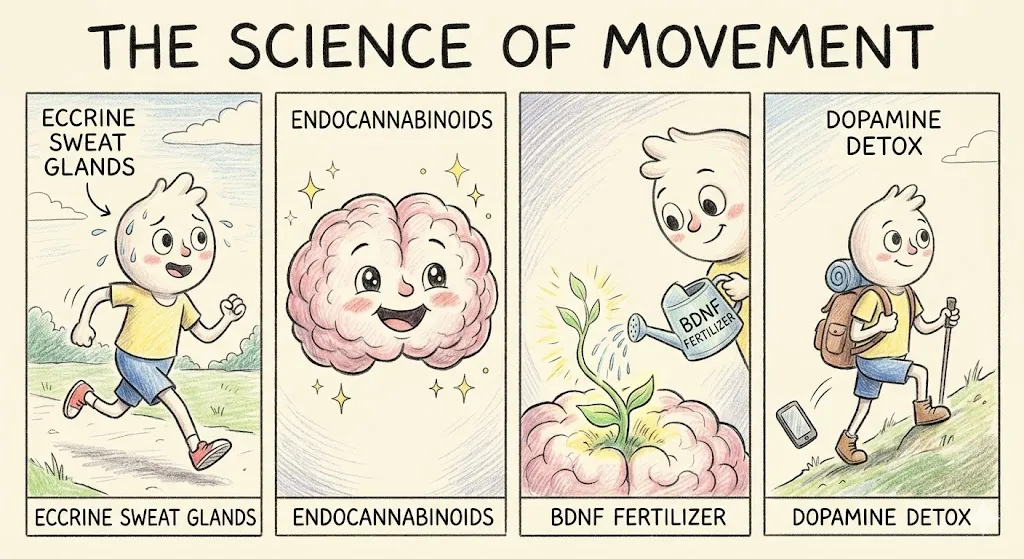
Humans are actually built for endurance running and persistence hunting. While humans are terrible sprinters compared to cheetahs, we are arguably the best long-distance runners in the animal kingdom. This is because we cool ourselves via millions of eccrine sweat glands rather than panting. Because of this ability, our early ancestors could perform 'persistence hunting'. They would chase prey during the hottest part of the day until the animal collapsed from heat exhaustion.
Vocabulary_explanations
Endurance: The ability to keep doing something difficult for a long time.Persistence hunting: A hunting technique where predators chase their prey until the prey is too tired to run.Sprinters: People or animals that run very fast over a short distance.Arguably: Used when giving an opinion that you think can be shown to be true.Sweat glands: Small parts in the skin that produce liquid to cool the body.Panting: Breathing with short, quick breaths, like a dog does when it is hot.Ancestors: People related to you who lived a long time ago.Collapsed: Fell down suddenly because of being very weak or tired.Exhaustion: The state of being extremely tired.Questions:- Question: Humans are better at sprinting short distances than cheetahs.Options:
- True
- False
Answer: False - Question: How do humans cool their bodies during a long run?Options:
- A) By panting heavily
- B) By sweating through glands
- C) By drinking cold water
Answer: B) By sweating through glands - Question: What is 'persistence hunting'?Options:
- A) Chasing prey until it collapses from the heat
- B) Hiding and waiting for prey to walk by
- C) Running away from larger animals
Answer: A) Chasing prey until it collapses from the heat
- Part_number: 2Text:
For decades, scientists attributed the 'runner's high' solely to endorphins. Research shows that running releases endocannabinoids and endorphins, which diminish pain and cause euphoria. However, endorphins are large molecules that cannot easily cross the blood-brain barrier. Recent studies have revealed that endocannabinoids are actually the primary drivers of this euphoria and pain reduction. Endocannabinoids are the body's self-produced version of the chemicals found in cannabis, and they easily enter the brain.
Vocabulary_explanations
Attributed: Believed that something was caused by a specific thing.Solely: Only; not involving anything else.Diminish: To make something smaller or less.Euphoria: A feeling of intense happiness and excitement.Molecules: The smallest unit of a chemical substance.Blood-brain barrier: A protective layer that controls what enters the brain from the blood.Primary drivers: The main causes or reasons for something happening.Self-produced: Made naturally by the body itself.Questions:- Question: Endorphins are very small molecules that easily enter the brain.Options:
- True
- False
Answer: False - Question: What is the main chemical responsible for a 'runner's high'?Options:
- A) Endorphins
- B) Endocannabinoids
- C) Adrenaline
Answer: B) Endocannabinoids - Question: What effect do these chemicals have on the body?Options:
- A) They increase pain and tiredness
- B) They cause sadness and anger
- C) They diminish pain and cause euphoria
Answer: C) They diminish pain and cause euphoria
- Part_number: 3Text:
Aerobic exercise treats depression and boosts serotonin. It is one of the most thoroughly documented non-pharmacological interventions for mild to moderate depression. Exercise increases the availability of neurotransmitters like serotonin, dopamine, and norepinephrine. Furthermore, aerobic exercise stimulates the release of Brain-Derived Neurotrophic Factor, or BDNF. BDNF is a protein that acts like fertilizer for the brain. It promotes the growth of new neurons in the hippocampus, a region often shrunken in chronically depressed patients.
Vocabulary_explanations
Aerobic: Exercise that needs a lot of oxygen, like running or swimming.Documented: Recorded or proven in scientific studies.Non-pharmacological: Treatments that do not use medicine or drugs.Interventions: Actions taken to improve a medical condition or illness.Neurotransmitters: Chemicals in the brain that send messages between cells.Stimulates: Causes something to become more active or start working.Fertilizer: A substance that helps things grow strong and healthy.Neurons: Cells in the nervous system that carry information.Shrunken: Become smaller in size.Questions:- Question: Aerobic exercise can be a treatment for mild to moderate depression.Options:
- True
- False
Answer: True - Question: What does the protein BDNF act like in the brain?Options:
- A) A medicine that stops pain
- B) Fertilizer that promotes neuron growth
- C) A wall that blocks negative thoughts
Answer: B) Fertilizer that promotes neuron growth - Question: Which part of the brain is often smaller in chronically depressed patients?Options:
- A) The hippocampus
- B) The heart
- C) The motor cortex
Answer: A) The hippocampus
- Part_number: 4Text:
Running reduces 'neural noise' and triggers the incubation effect. In neuroscience, this reduction of noise is linked to a theory called Transient Hypofrontality. When you engage in intense aerobic exercise, the brain has to reroute metabolic resources away from the prefrontal cortex and toward the motor cortex. This temporary shutting down of the overthinking brain leads to a peaceful flow state. Furthermore, doing a low-cognitive-load task like running allows the brain's default mode network to subconsciously connect ideas.
Vocabulary_explanations
Neural noise: Too many extra thoughts and background activity happening in the brain.Incubation effect: When taking a break from a problem helps your brain solve it naturally in the background.Transient: Lasting only for a short time; temporary.Reroute: To send something on a different path or to a different place.Metabolic resources: Energy, oxygen, and blood flow that the body uses to work.Prefrontal cortex: The part of the brain used for complex thinking and planning.Subconsciously: Doing something without actively thinking about it.Questions:- Question: Running increases 'neural noise' and makes you overthink more.Options:
- True
- False
Answer: False - Question: Where does the brain send its resources during intense aerobic exercise?Options:
- A) To the prefrontal cortex
- B) To the stomach
- C) To the motor cortex
Answer: C) To the motor cortex - Question: What is a 'low-cognitive-load' task?Options:
- A) A difficult math problem
- B) A simple activity that doesn't require deep thinking
- C) Learning a new language
Answer: B) A simple activity that doesn't require deep thinking
- Part_number: 5Text:
Hiking can act as a dopamine detox. Modern life bombards us with supernormal stimuli, like smartphones and highly palatable junk food, which down-regulate our dopamine receptors. Because of this, normal life can feel boring. By removing these artificial spikes and enduring voluntary physical hardship, the brain's reward system resensitizes. This means a return to baseline makes simple, natural rewards feel intensely satisfying. Ultimately, the physiological and psychological benefits of walking, running, and carrying loads across long distances are deeply wired into human biology.
Vocabulary_explanations
Detox: A period when you stop taking or doing unhealthy things.Bombards: To attack someone with a lot of information, questions, or things all at once.Supernormal stimuli: Things in modern life that are unnaturally exciting and rewarding.Palatable: Having a very pleasant or delicious taste.Down-regulate: To decrease the amount or sensitivity of something in the body.Enduring: Suffering through something difficult with patience.Resensitizes: To become sensitive and able to feel normal rewards again.Baseline: A normal or starting level before any changes happen.Questions:- Question: Smartphones and junk food make our brain's dopamine receptors more sensitive to simple things.Options:
- True
- False
Answer: False - Question: How does hiking help act as a 'dopamine detox'?Options:
- A) By removing artificial spikes in dopamine and resetting the brain
- B) By giving us more access to highly palatable junk food
- C) By allowing us to use our smartphones in nature
Answer: A) By removing artificial spikes in dopamine and resetting the brain - Question: What happens when you return to a 'baseline' dopamine level?Options:
- A) You feel angry and tired all the time
- B) Simple, natural rewards feel intensely satisfying
- C) You stop producing any dopamine
Answer: B) Simple, natural rewards feel intensely satisfying
Critical Thinking
Title: Think and DiscussInstructions:Based on the text, how does the modern lifestyle (smartphones, junk food) conflict with how human biology evolved for exercise and survival?
If you wanted to use the 'incubation effect' to solve a difficult problem at work or school, what specific physical activity would you plan to do, and why?
References
Recommended for You

Smart Study Secrets: Easy Ways to Ace Your Tests
Discover easy, science-backed study tips for middle schoolers to improve memory, prepare for exams, and study with confi...

Study Smarter, Not Harder: Science-Backed Exam Strategies
Discover science-backed study tips for middle schoolers to prepare for exams, improve memory, beat stress, and achieve t...

Interviews on AI: Thai Graduates at a Career Crossroads
Explore three personal interview perspectives on how AI will shape job opportunities for university graduates in Thailan...