
The Reversal of the Flynn Effect: Are IQ Scores Dropping?
Explore the recent phenomenon of declining IQ scores in youth across several developed countries and the potential reasons behind this worrying trend.
Title
The Reversal of the Flynn Effect: Are IQ Scores Dropping?Seo_intro
Explore the recent phenomenon of declining IQ scores in youth across several developed countries and the potential reasons behind this worrying trend.
Parts
- Part_number: 1Text:
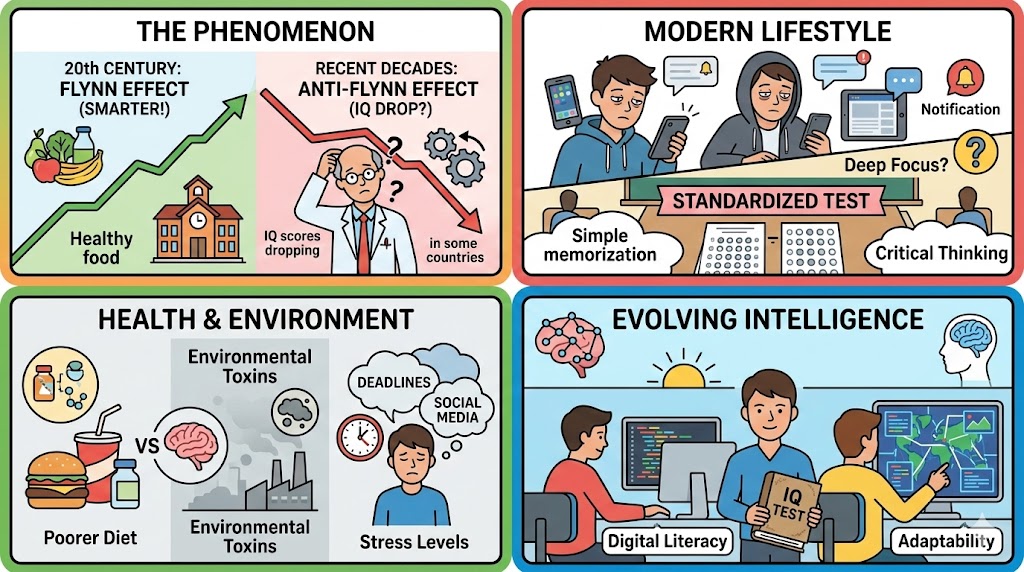
For most of the 20th century, intelligence quotient (IQ) scores consistently increased around the world. This positive trend, known as the Flynn effect, was linked to better nutrition, improved education, and healthier environments. However, in recent decades, researchers have noticed a worrying shift. In several developed countries, such as Norway, Denmark, and the UK, the IQ scores of young people are actually lower than those of previous generations. This phenomenon is often called the "anti-Flynn effect." Scientists are puzzled by this decline and are urgently trying to figure out why modern youth might be scoring lower on traditional intelligence tests.
Vocabulary_explanations
Intelligence quotient ( I Q): A number representing a person's reasoning ability, measured using problem-solving tests.Consistently: Always behaving or happening in a similar, usually positive, way.Trend: A general direction in which a situation is changing or developing.Nutrition: The process of getting the right kind of food for health and growth.Decades: Periods of ten years.Worrying: Making you feel anxious or concerned.Shift: A slight change in position, direction, or tendency.Generations: All of the people born and living at about the same time.Phenomenon: A fact or situation that is observed to exist or happen, especially one whose cause is in question.Puzzled: Confused because you do not understand something.Questions:- Question: What is the 'Flynn effect'?Options:
- A) The decrease of IQ scores in the 20th century
- B) The consistent increase of IQ scores in the 20th century
- C) The invention of modern IQ tests
Answer: B) The consistent increase of IQ scores in the 20th century - Question: Researchers have found that youth in all countries are getting smarter.Options:
- True
- False
Answer: False - Question: How do scientists feel about the 'anti-Flynn effect'?Options:
- A) They are puzzled and want to know the reasons
- B) They are excited and happy about it
- C) They do not care about the decline
Answer: A) They are puzzled and want to know the reasons
- Part_number: 2Text:
So, what is causing this decline in IQ scores? One major suspect is the rapid change in our technological environment. Today's youth spend a massive amount of time on smartphones and social media. While these devices provide instant information, they might reduce our ability to focus deeply and solve complex problems. Furthermore, changes in educational systems might also play a role. Some critics argue that modern schools focus too much on passing standardized tests rather than developing critical thinking and logic skills. If students are not challenged to think analytically, their performance on traditional cognitive tests may naturally drop.
Vocabulary_explanations
Decline: A continuous decrease in the number, value, or quality of something.Major suspect: One of the main things thought to be responsible for a problem.Rapid: Happening in a short amount of time; very fast.Massive: Exceptionally large in amount, degree, or size.Devices: Pieces of mechanical or electronic equipment made for a specific purpose.Instant: Happening or coming immediately.Complex: Consisting of many different and connected parts; not simple.Critics: People who express disapproval or point out the flaws in something.Standardized tests: Exams that require all test takers to answer the same questions in the same way.Analytically: In a way that involves examining things closely and logically.Questions:- Question: What is one potential negative effect of spending too much time on smartphones?Options:
- A) It improves our ability to focus deeply
- B) It may reduce our ability to solve complex problems
- C) It helps us pass standardized tests easily
Answer: B) It may reduce our ability to solve complex problems - Question: Modern schools are often criticized for focusing too much on logic skills.Options:
- True
- False
Answer: False - Question: Why might performance on cognitive tests drop according to the text?Options:
- A) Students are not challenged to think analytically
- B) The tests are too easy for modern students
- C) Students have too much free time
Answer: A) Students are not challenged to think analytically
- Part_number: 3Text:
Besides technology and schooling, environmental factors could also be to blame. Some researchers suggest that poorer diets, lacking essential nutrients, might negatively impact brain development. Others point to an increase in environmental toxins or even higher stress levels in modern society. However, it is also crucial to question the IQ tests themselves. Do these tests accurately measure modern intelligence? The skills needed to succeed today, like digital literacy and adaptability, might not be captured by traditional IQ assessments. Therefore, while the drop in scores is concerning, it might just mean that the nature of human intelligence is evolving.
Vocabulary_explanations
Environmental factors: Things in our surroundings that affect our development or behavior.To blame: To be the reason for something bad that happens.Essential nutrients: Vitamins and minerals that the body needs but cannot make itself.Impact: To have a strong effect on someone or something.Toxins: Poisonous substances, often produced by living organisms or human industry.Crucial: Extremely important or necessary.Accurately: In a way that is correct and exact, without mistakes.Digital literacy: The ability to use information and communication technologies effectively.Adaptability: The quality of being able to adjust to new conditions.Evolving: Developing gradually, often into a better or more complex state.Questions:- Question: What environmental factor is mentioned as a potential reason for lower IQ scores?Options:
- A) Warmer weather
- B) Poorer diets lacking essential nutrients
- C) Too much exercise
Answer: B) Poorer diets lacking essential nutrients - Question: The text suggests that traditional IQ tests perfectly measure the skills needed for modern life.Options:
- True
- False
Answer: False - Question: What modern skill might traditional IQ tests fail to measure?Options:
- A) Basic mathematics
- B) Spelling
- C) Digital literacy
Answer: C) Digital literacy