
Rudyard, Michigan: A Town Named by a Fan
Discover the unique history of Rudyard, Michigan. Named after a famous author, this town has a story involving railroads and owls.
Title
Rudyard, Michigan: A Town Named by a FanSeo_intro
Discover the unique history of Rudyard, Michigan. Named after a famous author, this town has a story involving railroads and owls.
Parts
- Part_number: 1Text:
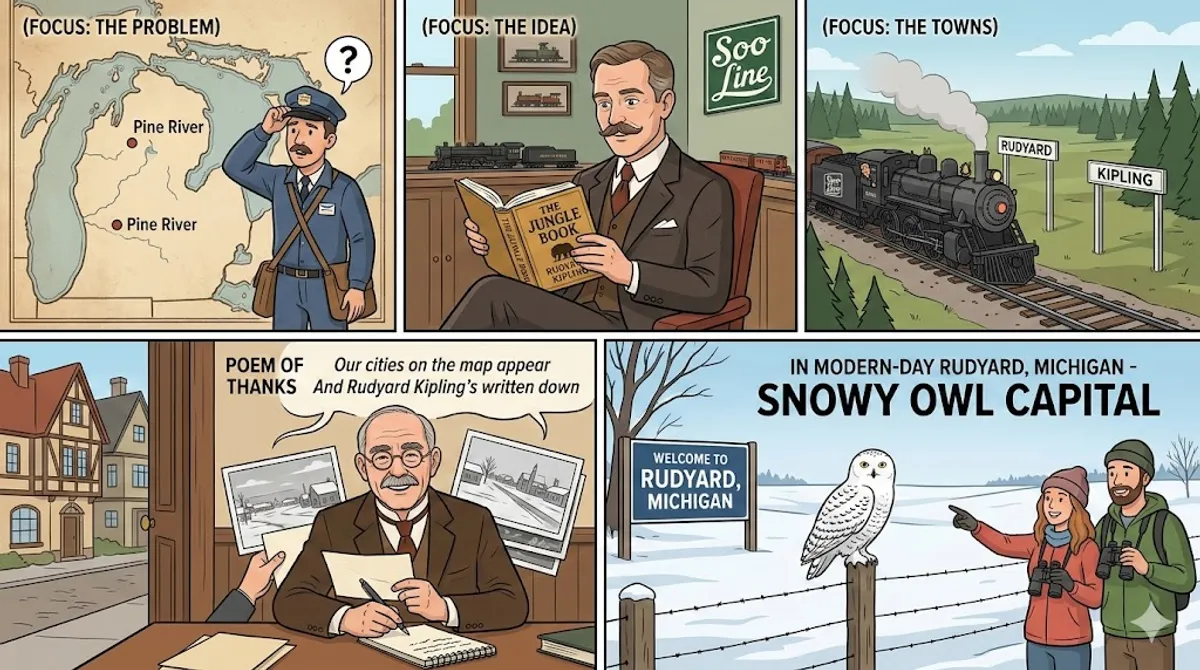
In the late 19th century, a small community in Michigan's Upper Peninsula was known as Pine River. However, there was a problem: another town in Michigan already had the same name. To avoid confusion, the Post Office Department asked for a change. In 1890, a man named Frederick Douglas Underwood suggested the name 'Rudyard.' Underwood was an executive for the Soo Line Railroad. He was also a huge fan of the British author Rudyard Kipling. He decided to name two different railroad stops after his favorite writer: Rudyard and Kipling.
Vocabulary_explanations
Community: A group of people living in the same place or having a particular characteristic in common.Upper Peninsula: The northern part of the state of Michigan, known for its forests and lakes.Confusion: A situation where people do not understand something clearly or mistake one thing for another.Post Office Department: The government organization responsible for sending and receiving mail.Executive: A person with senior managerial responsibility in a business organization.Railroad: A track or set of tracks made of steel rails along which passenger and freight trains run.Fan: A person who has a strong interest in or admiration for a particular person or thing.British: Relating to Great Britain or the United Kingdom.Stops: Places where a train or bus regularly stops for passengers to get on or off.Favorite: Preferred above all others of the same kind.Questions:- Question: The original name of the town was Pine River.Options:
- True
- False
Answer: True - Question: Who suggested the name 'Rudyard'?Options:
- A) Rudyard Kipling
- B) Frederick Douglas Underwood
- C) A local postman
Answer: B) Frederick Douglas Underwood - Question: Why did the town need to change its name?Options:
- A) People didn't like Pine River
- B) To avoid confusion with another town
- C) Because the railroad company demanded it
Answer: B) To avoid confusion with another town
- Part_number: 2Text:
The two towns, Rudyard and Kipling, are located about 100 miles apart. While Rudyard is in Chippewa County, its 'twin,' Kipling, is near the town of Gladstone. Underwood's decision to name these locations after a living author was quite unusual at the time. Rudyard Kipling was a very famous Nobel laureate, known for writing 'The Jungle Book.' When the author heard that two towns in America were named after him, he felt very honored. He was curious about these places in the wilderness of Michigan and wanted to see what they looked like.
Vocabulary_explanations
Located: Situated in a particular place.Miles: A unit of linear measure equal to 1,760 yards (approximately 1.6 kilometers).Twin: One of two things that are very similar or closely connected.Decision: A conclusion or resolution reached after consideration.Unusual: Not habitually or commonly occurring or done.Nobel laureate: A person who has been awarded a Nobel Prize for great achievements.Honored: Feeling proud and happy because of something special that has happened.Curious: Eager to know or learn something.Wilderness: An uncultivated, uninhabited, and inhospitable region.Famous: Known about by many people.Questions:- Question: How far apart are the towns of Rudyard and Kipling?Options:
- A) 10 miles
- B) 50 miles
- C) 100 miles
Answer: C) 100 miles - Question: Rudyard Kipling was a Nobel laureate.Options:
- True
- False
Answer: True - Question: How did Kipling feel about having towns named after him?Options:
- A) Angry
- B) Honored
- C) Bored
Answer: B) Honored
- Part_number: 3Text:
Kipling was so pleased that he wrote a letter to Underwood. In the letter, he said he would take a 'deep interest' in the welfare of the towns. He even asked Underwood to send him photographs of both Rudyard and Kipling so he could see his namesakes. The author was so inspired that he even wrote a short, funny poem about the situation. He liked the idea that his name was appearing on maps in the United States. This connection between a British literary giant and a small Michigan town remains a proud part of local history today.
Vocabulary_explanations
Welfare: The health, happiness, and fortunes of a person or group.Photographs: Pictures made using a camera.Namesakes: People or things that have the same name as another.Inspired: Feeling full of energy and desire to do something creative.Situation: A set of circumstances in which one finds oneself.Connection: A relationship in which a person, thing, or idea is linked or associated with something else.Literary: Concerning the writing, study, or content of literature.Giant: A person of great importance or reputation in a particular field.Remains: Continues to possess a particular quality or be in a particular state.Local: Relating or restricted to a particular area or one's neighborhood.Questions:- Question: What did Kipling ask Underwood to send him?Options:
- A) Money
- B) Photographs
- C) Books
Answer: B) Photographs - Question: Kipling wrote a poem about the towns.Options:
- True
- False
Answer: True - Question: What did Kipling say he would take a 'deep interest' in?Options:
- A) The railroad business
- B) The welfare of the towns
- C) Michigan politics
Answer: B) The welfare of the towns
- Part_number: 4Text:
Interestingly, Rudyard Kipling’s own name has a geographical origin. His parents, Alice and Lockwood Kipling, met and fell in love at Rudyard Lake in Staffordshire, England. They liked the place so much that they named their son after it. Therefore, the town in Michigan is indirectly named after a beautiful lake in the United Kingdom. This history shows how names can travel across oceans and through generations. It is a classic piece of 'Upper Peninsula lore,' which refers to the traditional stories and history of this specific northern region of Michigan.
Vocabulary_explanations
Geographical: Based on or derived from the physical features of an area.Origin: The point or place where something begins, arises, or is derived.Fell in love: To develop a strong romantic attraction for someone.Indirectly: In a way that is not directly or immediately connected.Generations: All of the people born and living at about the same time, regarded collectively.Lore:A body of traditions and knowledge on a subject or held by a particular group, typically passed on by word of mouth.
Traditional: Existing in or as part of a tradition; long-established.Region: An area, especially part of a country or the world having definable characteristics.Specific: Clearly defined or identified.Across: From one side to the other of a place or area.Questions:- Question: Where did Rudyard Kipling's parents meet?Options:
- A) In Michigan
- B) At Rudyard Lake in England
- C) In a library
Answer: B) At Rudyard Lake in England - Question: The author was named after a lake.Options:
- True
- False
Answer: True - Question: What does 'lore' refer to in this text?Options:
- A) Scientific data
- B) Traditional stories and history
- C) Law books
Answer: B) Traditional stories and history
- Part_number: 5Text:
Today, Rudyard is known for more than just its famous name. It is officially recognized as the 'Snowy Owl Capital of Michigan.' Every winter, many snowy owls migrate to the area from the Arctic. They are attracted to the flat, open agricultural fields because they look like the frozen tundra. Birdwatchers and nature lovers visit Rudyard to see these beautiful white birds. While the railroad is no longer the main focus of the town, the legacy of Frederick Underwood and Rudyard Kipling lives on through the town's unique identity and its natural beauty.
Vocabulary_explanations
Recognized: Identified from having been encountered before; known.Capital: The most important town or city of a region.Migrate: Move from one region or habitat to another according to the seasons.Agricultural: Relating to agriculture or farming.Fields: Areas of open land, especially ones planted with crops.Tundra: A vast, flat, treeless Arctic region in which the subsoil is permanently frozen.Birdwatchers: People who observe birds in their natural habitat as a hobby.Legacy: Something handed down from an ancestor or a predecessor or from the past.Identity: The fact of being who or what a person or thing is.Natural beauty: The quality of being pleasing to the senses through nature.Questions:- Question: What is Rudyard's modern title?Options:
- A) The Railroad City
- B) Snowy Owl Capital of Michigan
- C) The Pine River Town
Answer: B) Snowy Owl Capital of Michigan - Question: Snowy owls migrate to Rudyard during the summer.Options:
- True
- False
Answer: False - Question: Why do snowy owls like Rudyard's fields?Options:
- A) There are many trees
- B) They look like the frozen tundra
- C) The weather is very hot
Answer: B) They look like the frozen tundra
Recommended for You
The Quagga Mussel Crisis in the Great Lakes
Explore the ongoing ecological and economic impact of quagga mussels in the Great Lakes, focusing on their distinct thre...
Michigan's Smelt Run Mania: A Springtime Tradition
Explore the lively tradition of smelt fishing in Michigan's Upper Peninsula, a nighttime spring event full of community ...
The Global Battle Against Malaria and Mosquito-Borne Pathogens
Explore the complex challenges of malaria and other mosquito-borne diseases in this B2 level guide to global health and ...