Conditionals & Wishes Mastery Speed Run
Master the tricky differences between first, second, and third conditionals, as well as present and past regrets using "wish" in this fast-paced B1-B2 grammar challenge.
Quick Grammar Review
Before you race against the clock, refresh your memory on these key grammar structures:
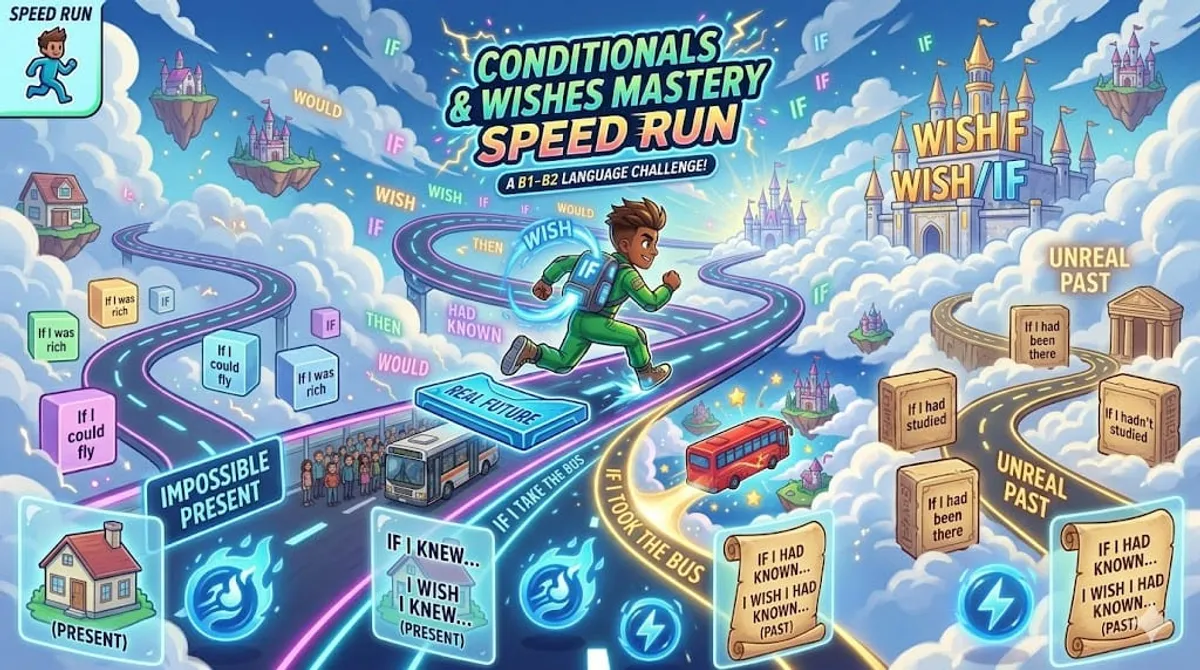
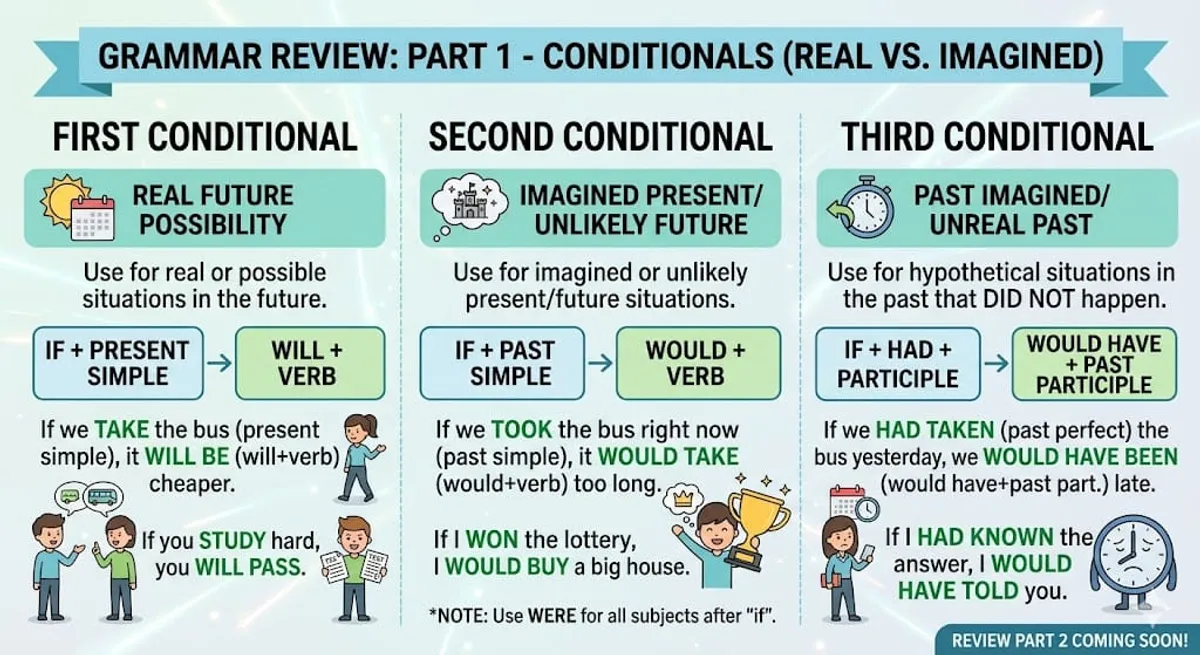
Conditionals: Real vs. Imagined
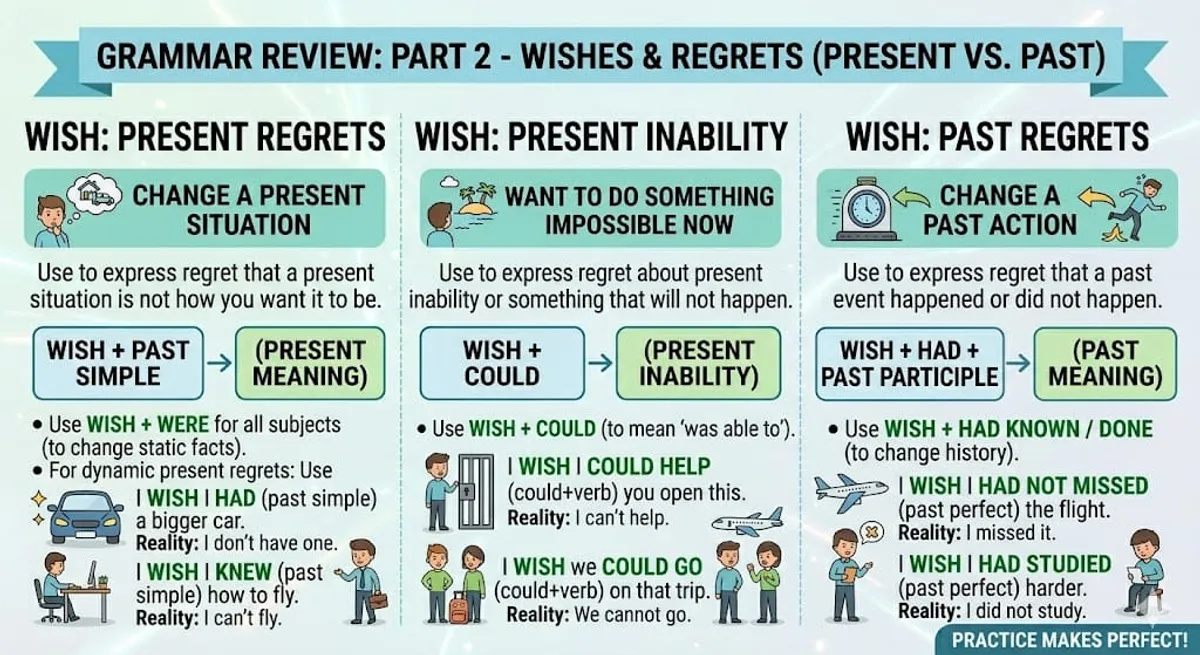
Wishes and Regrets
- Title: Conditionals & Wishes Mastery Speed RunQuestions:
- Category: First vs. Second ConditionalQuestion: If we take the bus, it ______ cheaper, but it will take much longer.Options:
- will be
- would be
- is
- had been
Answer: will beExplanation:We use **will + verb** (First Conditional) for real and possible future situations introduced by **if + present simple**.
- Category: First vs. Second ConditionalQuestion: I don't think I will win the lottery, but if I ______ the jackpot, I would buy a mansion.Options:
- win
- won
- had won
- would win
Answer: wonExplanation:We use **if + past simple** (Second Conditional) to talk about an imagined, unlikely, or impossible future situation.
- Category: First vs. Second ConditionalQuestion: If I ______ you, I wouldn't quit my job before finding a new one.Options:
- am
- was
- were
- would be
Answer: wereExplanation:In Second Conditional sentences, **were** is preferred instead of **was** after 'if' for all subjects.
- Category: First vs. Second ConditionalQuestion: If you found a valuable ring on the street, what ______ you do?Options:
- will
- would
- did
- can
Answer: wouldExplanation:For an imagined or unlikely scenario, use **would** in the question clause to match the past tense 'found'.
- Category: First vs. Second ConditionalQuestion: If we bought a car, we ______ drive to the beach every weekend instead of staying home.Options:
- could
- will
- can
- had
Answer: couldExplanation:**Could** means 'would be able to' and can be used as an alternative to 'would' in hypothetical outcomes.
- Category: First vs. Second ConditionalQuestion: If you ask him nicely, he ______ say yes, but it's not guaranteed.Options:
- might
- would
- did
- had
Answer: mightExplanation: **Might** can be used in conditional sentences to show that an outcome is possible but not certain. - Category: First vs. Second ConditionalQuestion: If I see him tomorrow, I ______ him your message.Options:
- will give
- would give
- give
- gave
Answer: will giveExplanation:This is a real future possibility (**First Conditional**), so we use **if + present** followed by **will + verb**.
- Category: First vs. Second ConditionalQuestion: If they offered you the job in Japan, ______ you accept it?Options:
- will
- would
- did
- do
Answer: wouldExplanation:The past form 'offered' sets up an unlikely or imagined future situation (**Second Conditional**), requiring **would**.
- Category: First vs. Second ConditionalQuestion: We ______ the match if we don't practice harder this week.Options:
- will lose
- would lose
- lost
- lose
Answer: will loseExplanation:The negative condition 'don't practice' is present tense, indicating a realistic threat (**First Conditional**), so we use **will lose**.
- Category: Present Imagined SituationsQuestion: I don't have enough money right now. If I ______ more money, I would buy that laptop.Options:
- have
- had
- would have
- had had
Answer: hadExplanation: We use **if + past simple** to imagine a present situation that is different from current reality. - Category: Present Imagined SituationsQuestion: I don't speak Italian. I wish I ______ it fluently.Options:
- speak
- spoke
- will speak
- have spoken
Answer: spokeExplanation:We use **wish + past simple** to express regret about a present situation that we want to be different.
- Category: Present Imagined SituationsQuestion: The weather is awful today. I wish it ______ sunny and warm.Options:
- is
- was
- were
- would be
Answer: wereExplanation:When using **wish** to express a present regret, **were** is the grammatically preferred form for all subjects.
- Category: Present Imagined SituationsQuestion: I have to work this weekend. I wish I ______ go to the concert with you.Options:
- can
- could
- would
- could have
Answer: couldExplanation: Use **wish + could** to express regret about a present inability (meaning 'I would be able to'). - Category: Present Imagined SituationsQuestion: If she ______ here right now, she would know exactly how to fix this issue.Options:
- is
- was
- were
- would be
Answer: wereExplanation: We use **if + were** to imagine a present situation that is completely contrary to fact. - Category: Present Imagined SituationsQuestion: I don't know the answer. I wish I ______ how to solve this puzzle.Options:
- know
- knew
- have known
- would know
Answer: knewExplanation:The past simple form **knew** is required after 'wish' to show that the current reality is regrettable.
- Category: Present Imagined SituationsQuestion: I don't know her phone number. If I ______ it, I would call her right now.Options:
- know
- knew
- had known
- would know
Answer: knewExplanation: To change a present reality ('I don't know'), use **if + past simple** to express the hypothesis. - Category: Present Imagined SituationsQuestion: I wish my apartment ______ closer to the city center. It takes an hour to commute.Options:
- is
- was
- were
- would be
Answer: wereExplanation: Using **were** after **wish** indicates an imagined change to a static present state. - Category: Past Imagined SituationsQuestion: If you had studied harder, you ______ the exam last week.Options:
- passed
- would pass
- would have passed
- will pass
Answer: would have passedExplanation:The Third Conditional uses **if + had + past participle** and **would have + past participle** for past events that didn't happen.
- Category: Past Imagined SituationsQuestion: I didn't see the ice on the sidewalk. If I ______ it, I wouldn't have fallen.Options:
- saw
- have seen
- had seen
- would see
Answer: had seenExplanation: To talk about an alternate past event, use the past perfect (**had seen**) in the 'if' clause. - Category: Past Imagined SituationsQuestion: We got lost because we forgot the map. If we had brought the map, we ______ lost.Options:
- wouldn't get
- hadn't gotten
- wouldn't have gotten
- didn't get
Answer: wouldn't have gottenExplanation: Use **wouldn't have + past participle** to express a hypothetical alternative past outcome. - Category: Past Imagined SituationsQuestion: I'm not hungry now because I ate lunch. If I hadn't eaten lunch, I ______ hungry right now.Options:
- would be
- would have been
- had been
- am
Answer: would beExplanation:This is a mixed conditional. We contrast a past condition (**hadn't eaten**) with a present result (**would be**).
- Category: Past Imagined SituationsQuestion: I spent all my savings last year. I wish I ______ that money.Options:
- didn't spend
- hadn't spent
- wouldn't spend
- haven't spent
Answer: hadn't spentExplanation: We use **wish + past perfect** (had/hadn't + past participle) to express regret about a past action. - Category: Past Imagined SituationsQuestion: If the goalkeeper had moved a bit faster, they ______ saved the definitive goal.Options:
- might have
- will have
- would
- had
Answer: might haveExplanation:**Might have** or **could have** are used instead of 'would have' to show a past outcome was possible but not certain.
- Category: Past Imagined SituationsQuestion: If I hadn't stayed up so late last night, I ______ so tired right now.Options:
- wouldn't be
- wouldn't have been
- hadn't been
- am not
Answer: wouldn't beExplanation:This is a **mixed conditional**. The past condition uses past perfect (**hadn't stayed**), but the result is happening *now*, requiring **wouldn't be**.
- Category: Past Imagined SituationsQuestion: I wish I ______ more attention during the safety briefing yesterday.Options:
- paid
- had paid
- would pay
- have paid
Answer: had paidExplanation:To express regret about a past action or event (yesterday), follow 'wish' with the past perfect (**had paid**).
- Category: Past Imagined SituationsQuestion: If we had caught the early train, we ______ arrived on time for the meeting.Options:
- could have
- can have
- will have
- had
Answer: could haveExplanation:**Could have + past participle** is used here to indicate a past ability or alternative outcome that didn't realize.
- Category: Uses of 'Wish'Question: Goodbye! I ______ you the best of luck with your job interview today.Options:
- wish
- hope
- want
- expect
Answer: wishExplanation: We use **wish + noun** (e.g., 'wish you luck') to express good intentions, not 'hope'. - Category: Uses of 'Wish'Question: The forecast says there might be storms. I ______ it doesn't rain tomorrow.Options:
- wish
- hope
- would wish
- desire
Answer: hopeExplanation: We use **hope** when we want something to happen in the future and think it is genuinely possible. - Category: Uses of 'Wish'Question: My brother is always borrowing my clothes without asking. I wish he ______ doing that!Options:
- stops
- stopped
- would stop
- had stopped
Answer: would stopExplanation:We use **I wish... would...** to complain about an annoying habit or to express a desire for someone's behavior to change.
- Category: Uses of 'Wish'Question: It's a pity you can't join us tonight. I wish you ______ come to the party.Options:
- can
- could
- would
- could have
Answer: couldExplanation: Use **wish + could** to express a present regret about an inability or impossibility. - Category: Uses of 'Wish'Question: I really regret missing your wedding last year. I wish I ______ gone.Options:
- could
- can
- could have
- would
Answer: could haveExplanation: Use **wish + could have** to express regret about an inability in the past. - Category: Uses of 'Wish'Question: This traffic is terrible. I wish the city ______ built a better public transit system years ago.Options:
- did
- had
- would
- has
Answer: hadExplanation: Regret about a past event or long-term lack of action requires **wish + past perfect** (had). - Category: Uses of 'Wish'Question: I wish it ______ stop raining! I want to go outside.Options:
- will
- would
- did
- had
Answer: wouldExplanation:Use **wish + would** when you are impatient or unhappy with a present situation (like the weather) and want it to change.
- Category: Uses of 'Wish'Question: I hope you ______ a wonderful time at the beach next weekend!Options:
- have
- wish
- would have
- had
Answer: haveExplanation:We use **hope** for positive future expectations that are possible, followed by a standard present or future tense structure.
- Category: Uses of 'Wish'Question: I wish the neighbors ______ playing loud music at midnight. I can't sleep!Options:
- will stop
- would stop
- stopped
- stop
Answer: would stopExplanation:Use **wish + would** to make a strong complaint or request for immediate behavioral change from someone else.