M3 Unit 1 Review
A quiz to review unit 1 of Wide Angle 2.
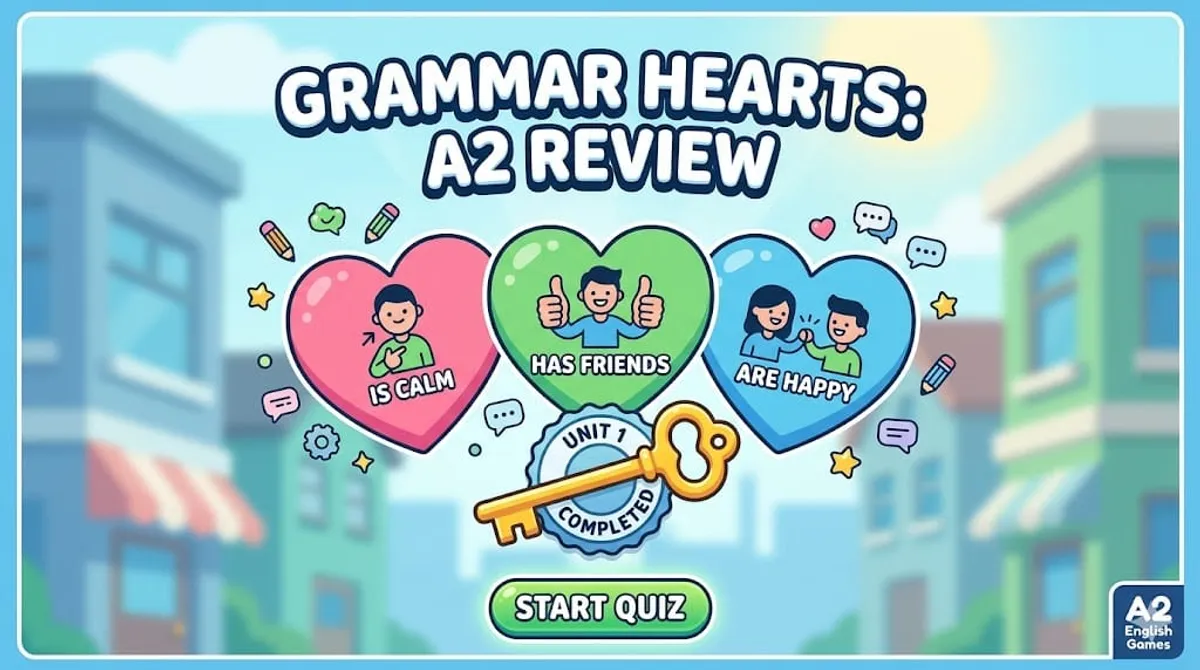
Today, we are reviewing the key grammar and vocabulary from Wide Angle 2 (Unit 1).
1. Personality Words (Positive vs. Negative)
When we talk about people, we use adjectives to describe their character. Some words are positive (good) and some are negative (bad).
- Positive Traits:
- Calm: Peaceful, quiet, and does not get angry easily. ("My teacher is very calm.")
- Honest: Always tells the truth and never lies or steals. ("An honest person never cheats.")
- Negative Traits:
- Lazy: Someone who does not want to work, study, or exercise. ("He is lazy and sleeps all day.")
- Shy: Quiet and nervous around new people. ("She is a bit shy at big parties.")
2. Describing People with BE and HAVE
Be careful! In English, we use Present Simple forms of BE and HAVE for different kinds of descriptions.
Using TO BE (am / is / are)
Use BE for personality traits, moods, and feelings.
- I am a bit shy.
- He / She / It is calm.
- You / We / They are happy.
Using TO HAVE (have / has)
Use HAVE for things people possess, relationships, or physical features like hair and eyes.
- I / You / We / They have a big house.
- He / She / It has a helpful brother.
3. Negative Contractions and Questions
To speak natural English, you need to know how to use short forms (contractions) and ask simple questions.
Negatives
- For descriptions: Add not to the verb BE.
- He is not lazy $\rightarrow$ He isn't lazy.
- They are not angry $\rightarrow$ They aren't angry.
- For possession: Use don't or doesn't.
- We don't have a car.
- He doesn't have a test today.
Questions
- Yes/No Questions with BE: Put the verb first!
- Is he a good boss?
- Are you happy in Thailand?
- Yes/No Questions with HAVE: Start with Do or Does.
- Do you have a brother?
- Does she have any homework?
4. Linking Ideas (and, also, too)
When you want to connect two similar ideas together, use these words:
- And: Connects two sentences.
- The weather is nice and the city is beautiful.
- Also: Goes in the middle of the sentence, usually before an adjective or verb.
- He is nice, and he is also very funny.
- Too: Means 'also', but it must go at the absolute end of the sentence.
- I love playing sports, and my friend loves sports too.
5. Changing the Strength of Adjectives (Adverbs of Degree)
Sometimes an adjective is small, and sometimes it is big. We use modifiers to change the strength.
5. Changing the Strength of Adjectives (Adverbs of Degree)
Sometimes a feeling or trait is small, and sometimes it is big. We use special words before our adjectives to change how strong they are.
Soft Modifiers (Small Amount)
If you want to make an adjective weaker or smaller, use a bit, a little, or sort of.
- I am a bit tired today. (I am only a small amount tired)
- The classroom is sort of noisy. (It is not too noisy, just a little)
Strong Modifiers (Big Amount)
If you want to make an adjective much stronger, use very or really.
- This room is really hot! (It is a lot of heat)
- My boss is very honest. (He always tells the truth)
Ready to Play?
Good luck with your Grammar Hearts game! Read the hints carefully, check if the sentence needs BE or HAVE, and watch your word order. You can do it!
- Title: A2 Grammar & Vocabulary Review
Hint
Summary: Present Simple (BE vs HAVE) & ModifiersContent:• Use **be** (am/is/are) for personality descriptions (e.g., *He is calm*). • Use **have/has** for physical traits or possessions (e.g., *She has a car*). • Use **and / also / too** to link matching ideas together. • Use **a bit / really** to change the strength of adjectives.
Questions:- Question: He is very friendly. He ___ many friends at school.Options:
- has
- is
- are
Explanation: Use **has** for third-person singular relationships or possessions. - Question: She never tells lies. She ___ an honest person.Options:
- is
- has
- are
Explanation: Use **is** with singular subjects to link directly to a personality trait. - Question: My brother does not like to work or study. He is ___.Options:
- lazy
- calm
- honest
Explanation: **Lazy** means someone who is unwilling to work or use energy. - Question: I am not stressed at all. I am a very ___ person.Options:
- calm
- lazy
- shy
Explanation: **Calm** means peaceful, quiet, and not worried. - Question: They ___ a big house in a very nice neighborhood.Options:
- have
- has
- is
Explanation: Use **have** for plural present simple possession with *they*. - Question: ___ you happy with your new English class?Options:
- Are
- Do
- Is
Explanation: Start a second-person (*you*) descriptive question with the verb **Are**. - Question: He ___ have a car, so he walks to work every day.Options:
- doesn't
- isn't
- don't
Explanation: Use **doesn't** for singular present simple negative possession verbs. - Question: She is a ___ shy when she meets new people.Options:
- bit
- too
- also
Explanation: The modifier phrase **a bit** means slightly or a little. - Question: I love playing sports, and I love music ___.Options:
- too
- also
- and
Explanation: **Too** means 'also' but must be placed at the absolute end of a sentence. - Question: Do you ___ any homework to complete tonight?Options:
- have
- has
- is
Explanation: Use the base form **have** after the helping verb *Do*. - Instruction: Fill in the blank:Question: My sister ___ a very calm person.Answer:
- is
- 's
Explanation: Use **is** or its contraction to describe a singular person's trait. - Instruction: Fill in the blank:Question: We ___ a nice teacher this semester.Answer:
- have
Explanation: Use **have** for plural possession or relationships in the present simple. - Instruction: Fill in the blank:Question: He ___ not lazy; he works hard every single day.Answer:
- is
Explanation: Use **is** before *not* to form a negative description for *he*. - Instruction: Fill in the blank:Question: ___ they have a large family?Answer:
- Do
Explanation: Start a present simple question with **Do** for the subject *they*. - Instruction: Fill in the blank:Question: ___ he an honest man?Answer:
- Is
Explanation: Start a descriptive yes/no question with **Is** for singular subjects. - Instruction: Fill in the blank with a word meaning tired but not very tired:Question: I am a ___ tired after that long drive.Answer:
- bit
- little
Explanation: Both **bit** and **little** complete the modifier phrase to mean slightly. - Instruction: Fill in the blank:Question: He is nice, and he is ___ very funny.Answer:
- also
Explanation: Use **also** mid-sentence to add another matching positive point. - Instruction: Fill in the blank:Question: This city is sort ___ noisy at night.Answer:
- of
Explanation: The phrase **sort of** fits together to mean moderately or somewhat. - Instruction: Fill in the blank:Question: She ___ long hair and beautiful green eyes.Answer:
- has
Explanation: Use **has** for third-person singular physical characteristics. - Instruction: Fill in the blank:Question: They ___ happy about the bad traffic.Answer:
- aren't
- are not
Explanation: Use the plural negative form **aren't** or **are not** for descriptions. - Sentence: He is very calm.Explanation: Subject + verb to be + modifier + adjective.
- Sentence: They have a car.Explanation: Subject + verb to have + article + noun.
- Sentence: She is an honest girl.Explanation: Subject + verb to be + article + adjective + noun.
- Sentence: We are not lazy.Explanation: Subject + verb to be + negative word + adjective.
- Sentence: Do you have a brother?Explanation: Auxiliary verb + subject + verb + article + noun.
- Sentence: Is he a good boss?Explanation: Verb to be + subject + article + adjective + noun.
- Sentence: I am a bit shy.Explanation: Subject + verb + modifier phrase + adjective.
- Sentence: My neighborhood is very quiet.Explanation: Possessive subject phrase + verb + modifier + adjective.
- Sentence: She has a nice home.Explanation: Subject + verb to have + article + adjective + noun.
- Sentence: They love sports too.Explanation: Subject + verb + noun object + ending word too.
Recommended for You
Whose is it?
Practice talking about ownership.

Conditionals & Wishes Mastery Speed Run
Master the tricky differences between first, second, and third conditionals, as well as present and past regrets using "wish" in this fast-paced B1-B2 grammar challenge.
Reviewing "Wish"
Explore the different uses of wish to express goodwill, regrets, and to make complaints.