Dreaming in English
Practice the second conditional, present wishes, and the special use of "were" by completing thirty interactive multiple-choice, fill-in-the-blank, and sentence scrambling challenges to master imaginary situations.
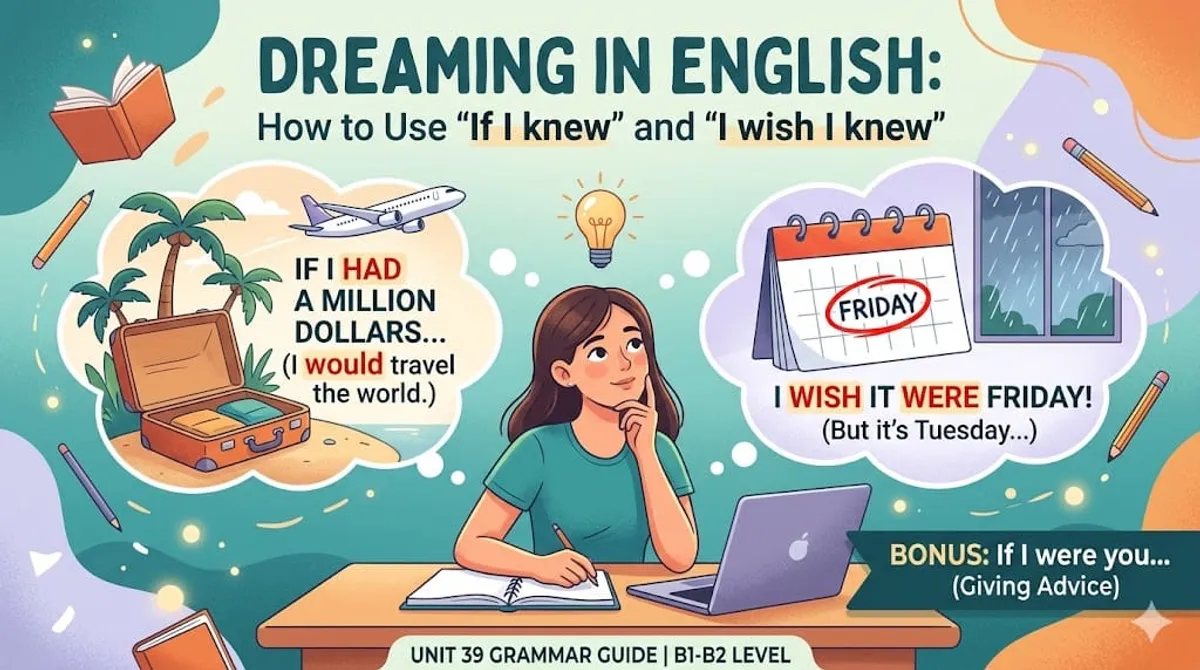
Do you ever daydream? Maybe you sit at your desk and think, "If I had a million dollars, I would travel the world." Or maybe you look out the window at the rain and think, "I wish it were sunny."
We all imagine different realities! In English, when we want to talk about imagined situations or regrets in the present, we use a very special trick: we use the past tense.
It sounds strange at first—why use the past tense for right now? Think of it this way: the past tense creates a "distance" from reality. It tells the listener, "This isn't real right now; I am just imagining it."
Let’s break down how to use "If I knew" and "I wish I knew" so you can start daydreaming in perfect English!
1. Imagining Different Situations: "If I knew..." (The Second Conditional)
We use If + Past Simple to talk about a present situation that is imaginary, unlikely, or impossible. To finish the thought, we use would + base verb for the result.
The Rule:
If + [Past Simple], subject + would + [Base Verb]
Examples:
- Imagination: "If I had more time, I would read more books."
- Reality: I don't have much time right now, so I don't read a lot.
- Imagination: "If we lived closer to the beach, we would go surfing every weekend."
- Reality: We don't live close to the beach.
- Imagination: "If I knew Paul's phone number, I would call him."
- Reality: I don't know his number, so I can't call him.
💡 Tip: You can also flip the sentence around. Just remember to take out the comma!
- I would read more books if I had more time.
2. Expressing Regret: "I wish I knew..."
Sometimes, we are unhappy with a present situation and we want it to be different. This is when we use the verb wish. Just like with the "If" sentences, we follow "wish" with the past simple to show that our desire is not our current reality.
The Rule:
I wish + subject + [Past Simple]
Examples:
- Wish: "I wish I knew Paul's phone number."
- Reality: It’s a pity that I don't know his number right now.
- Wish: "I wish I had a car."
- Reality: I have to take the bus, and I don't like it.
- Wish: "It's freezing today. I wish I lived in Thailand!"
- Reality: I live somewhere cold.
3. The Special Rule: Was vs. Were
Here is where English gets a little bit strange! When we use the verb "to be" in these imaginary sentences, we often use were instead of was for all subjects (I, he, she, it).
In formal English, were is always the best choice. In casual, spoken English, you will hear native speakers use both was and were, but were is very common.
Examples:
- If I were rich, I would buy a boat. (Not: If I was rich...)
- I wish it were Friday. (Not: I wish it was Friday...)
- If she were taller, she could play basketball.
Giving Advice: We use the phrase "If I were you..." all the time to give advice to our friends. We never say "If I was you."
- "If I were you, I would study for the test tonight."
- "I wouldn't buy that expensive jacket if I were you."
Summary Checklist ✅
To check your understanding, remember these three key points:
- Use the past simple to talk about imaginary situations in the present.
- Use "If [past simple] ... would [verb]" to explain what you would do in a dream situation.
- Use "I wish [past simple]" to talk about something you want to change right now.
- Use "were" instead of "was" for a more natural and correct sound, especially when giving advice (If I were you).
- Title: Second Conditional, Wishes, & 'Were'
Hint
Summary: Imagining Situations & Expressing RegretContent:Quick grammar guide: * **The Second Conditional:** Use *If + Past Simple, subject + would + Base Verb* for imaginary, unlikely, or impossible situations right now. (e.g., *If I had money, I would buy a car.*) * **Expressing Wishes:** Use *I wish + subject + Past Simple* to show you are unhappy with a current reality. (e.g., *I wish I knew his number.*) * **The Special 'Were' Rule:** In imaginary contexts, use **were** instead of *was* for all subjects (*I, he, she, it*). Use *If I were you...* to give advice.
Questions:- Question: If I ___ more time, I would read more books.Options:
- have
- had
- would have
Correct Index: 1Explanation: We use the **Past Simple** in the 'if' clause of a second conditional sentence. - Question: We would go surfing every weekend if we ___ closer to the beach.Options:
- lived
- live
- will live
Explanation: Use the **Past Simple** after 'if' to show that the current situation is imaginary. - Question: If I knew Paul's phone number, I ___ him.Options:
- will call
- called
- would call
Correct Index: 2Explanation: Use **would + base verb** to show the imaginary result. - Question: I don't like taking the bus. I wish I ___ a car.Options:
- have
- had
- would have
Correct Index: 1Explanation: Use the **Past Simple** after 'wish' to express a desire for a different present reality. - Question: It's freezing today! I wish I ___ in Thailand.Options:
- live
- lived
- am living
Correct Index: 1Explanation: The **Past Simple** form *lived* expresses a regret about your current location. - Question: If I ___ rich, I would buy a large boat.Options:
- was
- am
- were
Correct Index: 2Explanation: In formal English, **were** is preferred for all subjects in imaginary conditions. - Question: I wish it ___ Friday today, but it is only Tuesday.Options:
- is
- was
- were
Correct Index: 2Explanation: Use **were** with the subject *it* to express an imaginary wish. - Question: If she ___ taller, she could play on the basketball team.Options:
- were
- is
- will be
Explanation: Use **were** for singular subjects like *she* in second conditional clauses. - Question: If I were you, I ___ for the exam tonight.Options:
- will study
- would study
- studied
Correct Index: 1Explanation: The advice structure uses **would + base verb** in the result clause. - Question: I wouldn't buy that expensive jacket if I ___ you.Options:
- am
- was
- were
Correct Index: 2Explanation: The phrase **If I were you** is the standard formula for giving advice. - Instruction: Type the correct past simple form of the verb in parentheses:Question: If I ___ (know) the answer, I would tell you right away.Answer:
- knew
Explanation: The 'if' clause requires the Past Simple form **knew**. - Instruction: Type the correct past simple form of the verb in parentheses:Question: I wish I ___ (speak) French fluently.Answer:
- spoke
Explanation: We follow 'wish' with the Past Simple form **spoke** to show a present regret. - Instruction: Fill in the blank using the special rule for the verb 'to be':Question: If he ___ here right now, he would help us move the sofa.Answer:
- were
Explanation: Use **were** for singular subjects in imaginary conditions because he is not actually here. - Instruction: Type the correct past simple form of the verb in parentheses:Question: They would buy a house if they ___ (win) the lottery.Answer:
- won
Explanation: An imaginary condition uses the Past Simple form **won**. - Instruction: Fill in the blank using the special rule for the verb 'to be':Question: I am so tired. I wish I ___ in bed right now.Answer:
- were
Explanation: Use **were** with 'I' to express an imaginary present wish. - Instruction: Type the correct past simple form of the verb in parentheses:Question: If we ___ (live) in London, we would speak English every day.Answer:
- lived
Explanation: The condition clause requires the Past Simple form **lived**. - Instruction: Type the correct past simple form of the verb in parentheses:Question: She wishes she ___ (have) a bigger apartment.Answer:
- had
Explanation: Use **had** to express a desire for her current reality to be different. - Instruction: Fill in the blank to complete the standard advice phrase:Question: If I ___ you, I would accept the job offer.Answer:
- were
Explanation: Always use **were** in the phrase *If I were you*. - Instruction: Type the correct past simple form of the verb in parentheses:Question: I don't understand this game. I wish I ___ (know) the rules.Answer:
- knew
Explanation: The past form **knew** expresses a regret about a lack of knowledge in the present. - Instruction: Type the correct past simple form of the verb in parentheses:Question: He would fix the car if he ___ (have) the right tools.Answer:
- had
Explanation: The imaginary condition requires the Past Simple form **had**. - Sentence: If I had a bike I would ride it to school.Explanation: Structure: If + subject + past simple, subject + would + base verb.
- Sentence: She would help us if she could.Explanation: When the result clause comes first, do not place a comma before 'if'.
- Sentence: I wish I had a bigger bedroom.Explanation: Structure: Subject + wish + subject + past simple + object.
- Sentence: If I were you I would study tonight.Explanation: Giving advice: If + I + were + you, I + would + base verb.
- Sentence: I wish it were summer holidays now.Explanation: Expressing a wish using the special rule: subject + wish + it + were + noun phrase.
- Sentence: If it rained we would stay at home.Explanation: Structure: If + subject + past simple, subject + would + base verb.
- Sentence: She wishes she could play the guitar.Explanation: Use 'could' (the past form of can) to express a wish about an ability.
- Sentence: If he were a chef he would cook delicious food.Explanation: Remember to use 'were' for singular subjects like 'he' in imaginary conditions.
- Sentence: I would buy a boat if I were rich.Explanation: Result clause + if + subject + were + adjective (no comma needed).
- Sentence: I wish I knew how to swim.Explanation: Expressing a present regret: Subject + wish + subject + past simple + phrase.
Recommended for You
Whose is it?
Practice talking about ownership.

Conditionals & Wishes Mastery Speed Run
Master the tricky differences between first, second, and third conditionals, as well as present and past regrets using "wish" in this fast-paced B1-B2 grammar challenge.
M3 Unit 1 Review
A quiz to review unit 1 of Wide Angle 2.