How to Describe People
When to Use "Be" and "Have"
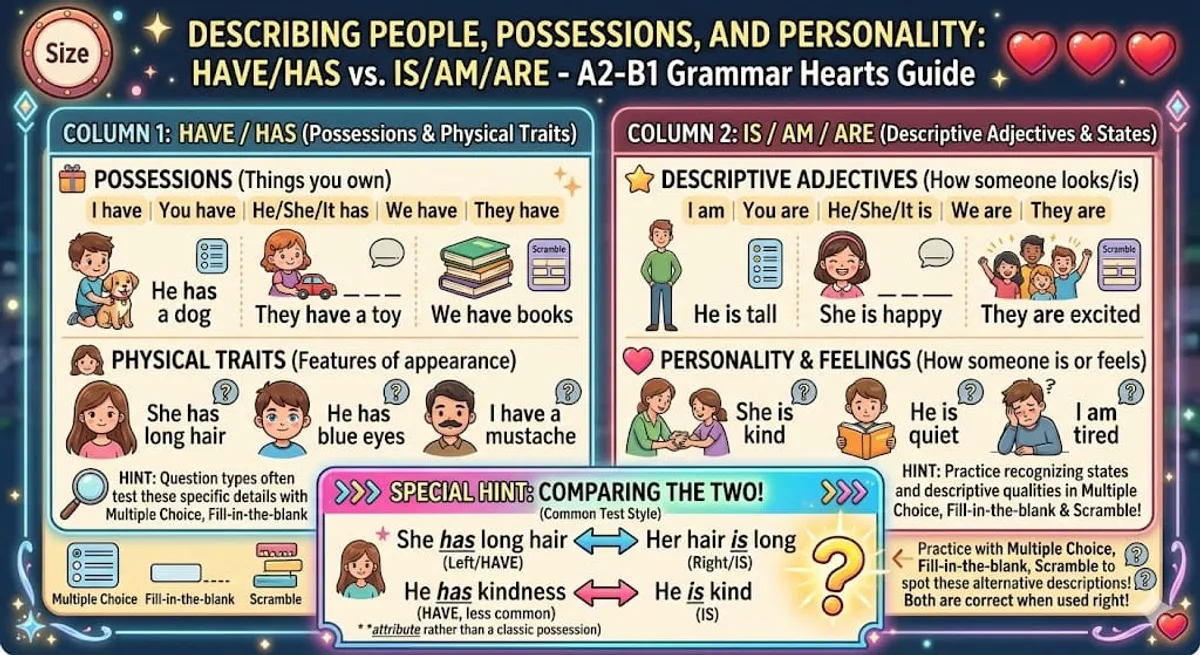
When we want to describe someone's appearance or personality in English, it can sometimes be tricky to choose the right verb. Should you say "Her hair is brown" or "She has brown hair"? Both are correct, but they use different grammar rules!
Here is a simple guide to help you remember:
1. Using the Verb "To Be" (am / is / are) We use the verb to be when we are talking about adjectives. Adjectives are words that describe nouns (like tall, short, funny, smart, brown).
Formula: Subject + be + adjective
- He is tall.
- My eyes are blue.
- I am very happy.
2. Using the Verb "To Have" (has / have) We use the verb to have when we are talking about possessions or physical traits. This means the person "owns" that feature. We use it with nouns (like hair, eyes, a beard, a car).
Formula: Subject + have/has + (adjective) + noun
- She has brown hair. (She owns the hair)
- They have blue eyes.
- John has a short beard.
Negatives: Subject + doesn't/don't have + noun.
- They don't have blue eyes.
- John doesn't have a short beard.
Quick Tip:
- Incorrect: She is long hair. (She is not the hair!)
- Correct: She has long hair. OR Her hair is long.
- Title: Describing People: Have vs Is
Hint
Summary: Using 'To Be' vs 'To Have'Content:Use the verb **to be (is/are/am)** with adjectives (e.g., 'Her hair **is** brown', 'He **is** tall'). Use the verb **to have (has/have)** with nouns to talk about physical traits or possessions (e.g., 'She **has** brown hair', 'They **have** blue eyes').
Questions:- Question: He ___ tall and thin.Options:
- is
- has
- are
Explanation: We use **is** because 'tall and thin' are adjectives describing him. - Question: She ___ beautiful blue eyes.Options:
- is
- has
- have
Correct Index: 1Explanation: We use **has** because 'blue eyes' is a physical trait she possesses. - Question: My sister ___ very funny and kind.Options:
- has
- have
- is
Correct Index: 2Explanation: We use **is** with personality adjectives like 'funny' and 'kind'. - Question: They ___ long curly hair.Options:
- have
- are
- has
Explanation: We use **have** for 'they' when talking about a physical trait like 'hair'. - Question: His nose ___ quite small.Options:
- has
- is
- are
Correct Index: 1Explanation: We use **is** because we are describing the noun 'nose' with the adjective 'small'. - Question: We ___ a new English teacher.Options:
- are
- is
- have
Correct Index: 2Explanation: We use **have** to show possession or relationship. - Question: The dog ___ a short tail.Options:
- has
- is
- have
Explanation: We use **has** for 'the dog' (it) when describing its body parts. - Question: Her brothers ___ very athletic.Options:
- have
- is
- are
Correct Index: 2Explanation: We use **are** for plural subjects ('brothers') with an adjective ('athletic'). - Question: I ___ dark hair and brown eyes.Options:
- have
- am
- has
Explanation: We use **have** with 'I' to describe physical traits. - Question: You ___ always very happy!Options:
- have
- are
- is
Correct Index: 1Explanation: We use **are** with 'you' and the adjective 'happy'. - Instruction: Fill in the blank:Question: She ___ a very friendly personality.Answer:
- has
Explanation: Use **has** to describe a trait someone possesses. - Instruction: Fill in the blank:Question: His hair ___ short and blonde.Answer:
- is
- 's
Explanation: Use **is** to link the subject 'hair' to the adjectives 'short and blonde'. - Instruction: Fill in the blank:Question: I ___ not very tall.Answer:
- am
- 'm
Explanation: Use **am** with 'I' and the adjective 'tall'. - Instruction: Fill in the blank:Question: They ___ three friendly cats.Answer:
- have
- 've
Explanation: Use **have** to indicate possession. - Instruction: Fill in the blank:Question: My grandfather ___ a white beard.Answer:
- has
Explanation: Use **has** for a physical feature belonging to 'my grandfather' (he). - Instruction: Fill in the blank:Question: Her new car ___ fast and red.Answer:
- is
- 's
Explanation: Use **is** with adjectives describing a singular noun ('car'). - Instruction: Fill in the blank:Question: We ___ big smiles on our faces.Answer:
- have
- 've
Explanation: Use **have** with 'we' to describe physical features we possess. - Instruction: Fill in the blank:Question: The children ___ energetic today.Answer:
- are
- 're
Explanation: Use **are** for plural subjects ('children') and the adjective 'energetic'. - Instruction: Fill in the blank:Question: He ___ a great sense of humor.Answer:
- has
Explanation: Use **has** to describe a personality trait he possesses. - Instruction: Fill in the blank:Question: My eyes ___ green.Answer:
- are
- 're
Explanation: Use **are** because 'eyes' is plural and 'green' is an adjective. - Sentence: She has long brown hair.Explanation: Subject (She) + verb (has) + adjectives (long brown) + noun (hair).
- Sentence: His eyes are very blue.Explanation: Subject (His eyes) + verb (are) + adverb (very) + adjective (blue).
- Sentence: They have a big beautiful house.Explanation: Subject (They) + verb (have) + article (a) + adjectives (big beautiful) + noun (house).
- Sentence: My friend is funny and smart.Explanation: Subject (My friend) + verb (is) + adjectives (funny and smart).
- Sentence: The cat has a long black tail.Explanation: Subject (The cat) + verb (has) + article (a) + adjectives (long black) + noun (tail).
- Sentence: We are happy with our new car.Explanation: Subject (We) + verb (are) + adjective (happy) + prepositional phrase (with our new car).
- Sentence: He has a very kind personality.Explanation: Subject (He) + verb (has) + article (a) + adverb (very) + adjective (kind) + noun (personality).
- Sentence: Her brother is tall and strong.Explanation: Subject (Her brother) + verb (is) + adjectives (tall and strong).
- Sentence: I have short curly red hair.Explanation: Subject (I) + verb (have) + adjectives (short curly red) + noun (hair).
- Sentence: The teacher is always very patient.Explanation: Subject (The teacher) + verb (is) + frequency adverb (always) + adverb (very) + adjective (patient).
Recommended for You
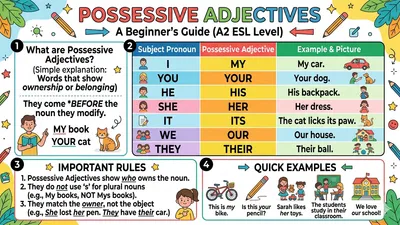
Whose is it?
Practice talking about ownership.

Conditionals & Wishes Mastery Speed Run
Master the tricky differences between first, second, and third conditionals, as well as present and past regrets using "wish" in this fast-paced B1-B2 grammar challenge.
M3 Unit 1 Review
A quiz to review unit 1 of Wide Angle 2.