If I Had Known!
How to Talk About Past Imagined Situations in English
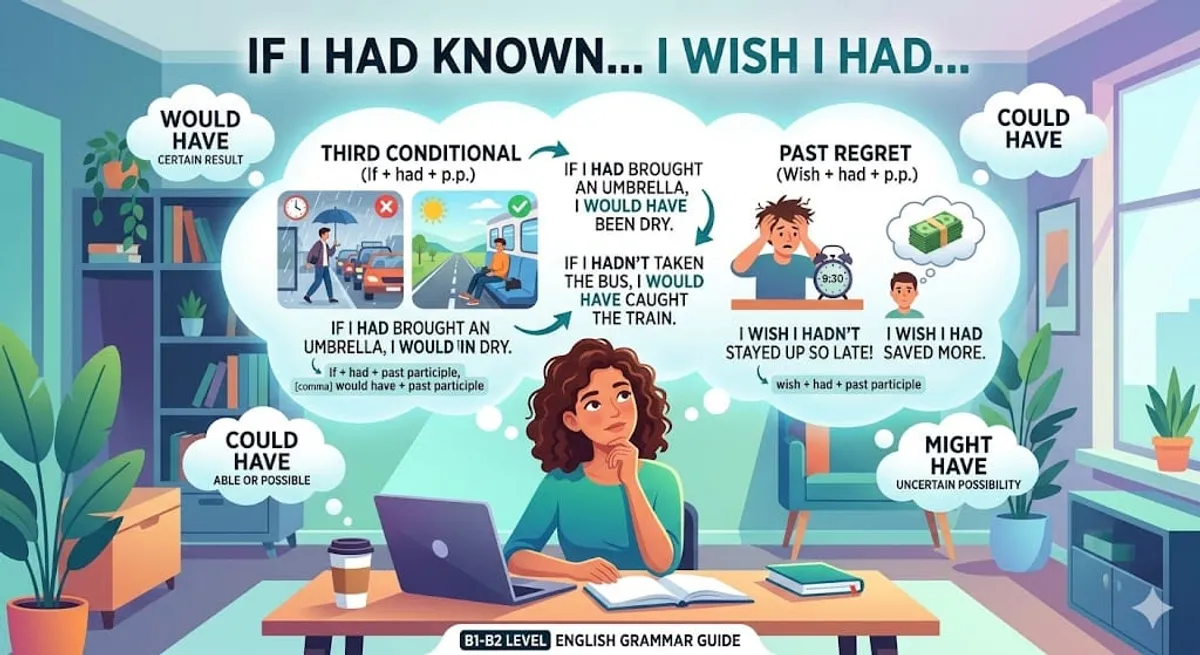
Have you ever made a mistake and wished you could travel back in time to fix it? We all have! Maybe you missed a train because you woke up late, or maybe you forgot your umbrella on a rainy day.
While we don't have a time machine, the English language gives us a special grammar tool to do exactly this: The Third Conditional. Today, we are going to look at how to talk about past events that never happened, how to express regret, and how to imagine different outcomes.
1. The Third Conditional: Changing the Past
When we want to imagine a different past, we use the Third Conditional. We are talking about an event that already happened (or didn't happen) and imagining a completely different result.
The Structure:
If + subject + had + past participle, subject + would have + past participle
Examples:
- If I had known it was your birthday, I would have bought you a gift.
(Reality: I didn't know it was your birthday, so I didn't buy a gift.) - If she had studied more, she would have passed the exam.
(Reality: She didn't study enough, so she failed.)
Tip: You can swap the order of the sentence. Just remember to remove the comma!
- I would have bought you a gift if I had known it was your birthday.
2. Present vs. Past Conditionals: What's the Difference?
It is easy to get confused between present imagined situations (Second Conditional) and past imagined situations (Third Conditional). Let's look at them side-by-side:
- Present Unreal (Second Conditional): "If I was hungry, I would eat a sandwich."
- Meaning: We are talking about right now. I am not hungry right now, so I am not eating.
- Past Unreal (Third Conditional): "If I had been hungry, I would have eaten a sandwich."
- Meaning: We are talking about yesterday (or earlier). I wasn't hungry then, so I didn't eat.
Another comparison:
- Present: If I had a car, I would drive to work today. (I don't own a car).
- Past: If I had had a car, I would have driven to work last year. (I didn't own a car last year, but I might now.).
(Note: Yes, "had had" is grammatically correct here! The first "had" is the helping verb, and the second "had" is the past participle of "have".)
3. "I Wish I Had...": Expressing Regret
When we feel bad about something we did (or didn't do) in the past, we use wish + past perfect. This is the classic structure for regret.
The Structure:
Subject + wish + subject + had + past participle
Examples:
- "Look at this rain! I wish I had brought my umbrella." (I didn't bring it).
- "I wish I hadn't eaten so much cake." (I ate too much cake, and now my stomach hurts).
- "She wishes she had accepted that job offer." (She declined it, and now she is sad about it).
4. Would have, Could have, Might have
In the Third Conditional, we don't always have to use "would have." We can change the meaning slightly by using "could have" or "might have."
- Would have (Certainty in the imagined past): You are 100% sure this was the result.
- If I had seen you, I would have said hello. (Definitely).
- Could have (Ability or Possibility): You had the ability or opportunity to do it, but you didn't.
- If you had asked me, I could have helped you. (I was able to help, but you didn't ask).
- Might have (Uncertainty): It is only a small possibility. You are not sure what the result would be.
- If we had left earlier, we might have avoided the traffic. (Maybe we would avoid it, maybe not. We aren't completely sure).
- Title: Third Conditional & Past Regret
Hint
Summary: Imagining a Different PastContent:Use the **Third Conditional** for past events that didn't happen: **If + had + past participle**, **would have + past participle**. Use **wish + had + past participle** to express past regret. *Tip:* You can also use **could have** (ability) or **might have** (possibility) instead of would have.
Questions:- Question: If it had rained, we ___ at home.Options:
- would stay
- would have stayed
- stayed
Correct Index: 1Explanation: We use **would have + past participle** for the result in the Third Conditional. - Question: I wish I ___ so much coffee yesterday.Options:
- hadn't drunk
- didn't drink
- not drink
Explanation: Use **wish + past perfect** to express regret about the past. - Question: If she had studied, she ___ the test.Options:
- passed
- would pass
- would have passed
Correct Index: 2Explanation: We use **would have + past participle** to show the imagined result. - Question: They ___ the bus if they had woken up earlier.Options:
- might catch
- could have caught
- catching
Correct Index: 1Explanation: We use **could have** to show a past possibility or ability. - Question: If I ___ you were sick, I would have visited.Options:
- know
- knew
- had known
Correct Index: 2Explanation: The condition part of the sentence needs the **past perfect** (had known). - Question: I wish we ___ our camera to the party.Options:
- brought
- had brought
- bring
Correct Index: 1Explanation: To regret something we didn't do, we use **wish + had + past participle**. - Question: If he had asked me, I ___ him.Options:
- would have helped
- will help
- help
Explanation: The imagined result of a past situation uses **would have + past participle**. - Question: We might have won the game if we ___ harder.Options:
- practiced
- had practiced
- practice
Correct Index: 1Explanation: The 'if' clause requires the **past perfect** (had + past participle). - Question: If you ___ the map, we wouldn't have gotten lost.Options:
- checked
- had checked
- check
Correct Index: 1Explanation: We use **past perfect** in the 'if' clause for past imagined situations. - Question: I wish she ___ me the truth earlier.Options:
- had told
- told
- tells
Explanation: Use **had + past participle** after wish to show past regret. - Instruction: Fill in the blank with the correct form:Question: If I had seen him, I ___ hello.Answer:
- would have said
- 'd have said
- could have said
- might have said
Explanation: We use **would have + past participle** for the imagined result. - Instruction: Fill in the blank with the correct form:Question: I wish I ___ an umbrella today. Now I am wet!Answer:
- had brought
- 'd brought
Explanation: Use **had + past participle** to express a wish about the past. - Instruction: Fill in the blank with the correct form:Question: She could have won if she ___ faster.Answer:
- had run
- 'd run
Explanation: The 'if' clause needs the **past perfect** (had + past participle). - Instruction: Fill in the blank with the correct negative form:Question: If they had known the price, they ___ it.Answer:
- would not have bought
- wouldn't have bought
Explanation: Use the negative **would not have + past participle**. - Instruction: Fill in the blank with the correct form:Question: He wishes he ___ more for the exam. He failed.Answer:
- had studied
- 'd studied
Explanation: Use **had studied** for something he regrets not doing. - Instruction: Fill in the blank with the correct form of the verb 'be':Question: We would have gone to the beach if the weather ___ nice.Answer:
- had been
- 'd been
Explanation: The past participle of 'be' is **been**. We need **had been**. - Instruction: Fill in the blank using 'could':Question: If you had called me, I ___ you.Answer:
- could have helped
- could've helped
Explanation: Use **could have + past participle** to show past ability. - Instruction: Fill in the blank with the negative form:Question: I wish I ___ that big burger. My stomach hurts.Answer:
- had not eaten
- hadn't eaten
Explanation: Use the negative **hadn't + past participle** for this regret. - Instruction: Fill in the blank using 'might':Question: If she had left on time, she ___ the train.Answer:
- might have caught
- might've caught
Explanation: Use **might have + past participle** to show uncertain possibility. - Instruction: Fill in the blank with the correct form:Question: They would have passed if they ___ harder.Answer:
- had tried
- 'd tried
Explanation: The condition requires the **past perfect** (had tried). - Sentence: If I had known, I would have come.Explanation: If + past perfect, subject + would have + past participle.
- Sentence: I wish I had saved more money.Explanation: Subject + wish + subject + had + past participle.
- Sentence: She would have called if she had had time.Explanation: You can put the 'would have' result clause before the 'if' clause.
- Sentence: We could have won if we had practiced.Explanation: 'Could have' shows past ability and goes before the 'if' clause here.
- Sentence: If it had rained, I would have stayed home.Explanation: Always use a comma when the 'If' clause starts the sentence.
- Sentence: He wishes he hadn't said that.Explanation: Negative regret uses hadn't + past participle.
- Sentence: They might have arrived earlier if they had driven.Explanation: 'Might have' expresses a possible but uncertain past result.
- Sentence: If you had listened, you would have understood.Explanation: If + past perfect, followed by the would have result.
- Sentence: I wish I had brought my jacket.Explanation: A classic structure for expressing past regret.
- Sentence: If she had asked, I would have helped.Explanation: Condition first, comma, then the imagined result.
Recommended for You
Whose is it?
Practice talking about ownership.

Conditionals & Wishes Mastery Speed Run
Master the tricky differences between first, second, and third conditionals, as well as present and past regrets using "wish" in this fast-paced B1-B2 grammar challenge.

M3 Unit 1 Review
A quiz to review unit 1 of Wide Angle 2.