Picture Perfect
Using quantifiers to talk about photography
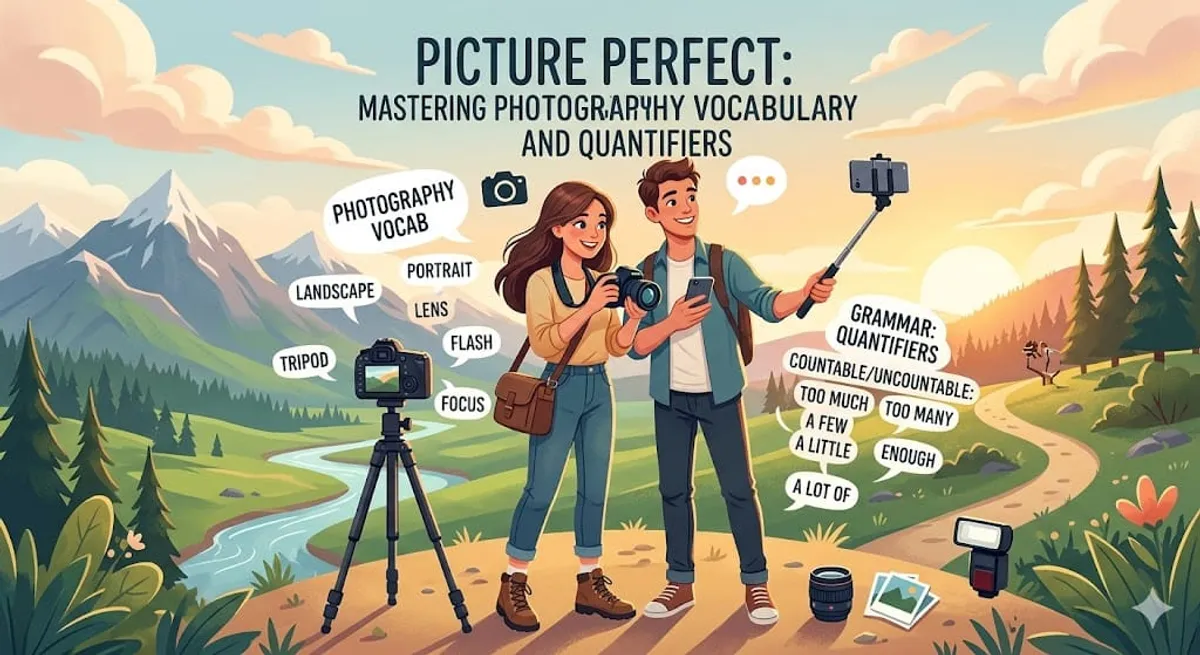
We all love taking photos, whether it's snapping a quick selfie with friends or capturing a beautiful sunset on vacation. But when it comes time to talk about those pictures in English, do you have the right words?
To help you level up your English skills (and maybe your photography skills, too!), let's review some essential camera vocabulary and learn how to use quantifiers to talk about amounts.
Essential Photography Vocabulary
Before you snap your next picture, make sure you know these key terms:
- Landscape vs. Portrait: A landscape is a wide photo of natural scenery, like mountains or a beach. A portrait is a photo focused on a person’s face.
- The Equipment: You look through the lens to see your subject. If it’s too dark, you might need a flash to add light. If your hands are shaking, put your camera on a tripod (a three-legged stand) to keep it still.
- The Composition: The things at the back of your picture are in the background, while things close to the camera are in the foreground. Make sure your main subject is sharp and clear, or "in focus"!
Grammar Check: Using Quantifiers
When talking about photography, we often need to talk about amounts—how much light we have, how many photos we took, or how much time we spent editing. To do this, we use quantifiers.
The secret to using quantifiers is knowing the difference between countable nouns (things you can count: photos, lenses, cameras) and uncountable nouns (things you can't count: light, time, money, equipment).
Too much vs. Too many:
- Use too much with uncountable nouns: "There is too much light; the photo is too bright."
- Use too many with countable nouns: "I took too many photos on my trip! My phone is full."
A little vs. A few:
- Use a little for small amounts of uncountable nouns: "I just need a little more time to edit this."
- Use a few for small amounts of countable nouns: "Can you give me a few tips for taking better portraits?"
Enough and A lot of:
Good news! You can use enough (the correct amount) and a lot of (a large amount) with both countable and uncountable nouns.
- "We have enough light." / "I have enough cameras."
- "She has a lot of experience." / "He takes a lot of pictures."
Ready to test your skills?
Now that you know the vocabulary and the grammar rules, it’s time to put your knowledge to the test. Play the Grammar Hearts challenge below and see if you can get a perfect score! Good luck!
- Title: Photography Vocabulary & Quantifiers
Hint
Summary: Mastering Quantifiers and Camera TermsContent:Use **too much** and **a little** for uncountable nouns (light, time, money). Use **too many** and **a few** for countable nouns (photos, cameras, lenses). Use **enough** when you have the correct amount, and **a lot of** for large quantities of both. Key photography terms: **landscape** (nature scenes), **portrait** (faces), **focus** (sharpness), and **tripod** (camera stand).
Questions:- Question: There isn't ___ light to take a good photo in this room.Options:
- enough
- too much
- a few
Explanation: We use 'enough' to say we have the required amount of an uncountable noun like light. - Question: There are ___ photos on my phone. I have no storage left!Options:
- too many
- too much
- a little
Explanation: We use 'too many' with plural countable nouns like photos. - Question: I only have ___ time to edit these pictures before the deadline.Options:
- a little
- a few
- many
Explanation: 'Time' is an uncountable noun, so we use 'a little' for a small amount. - Question: Can you give me ___ tips on how to use this camera?Options:
- a few
- a little
- much
Explanation: 'Tips' is a countable noun, so we use 'a few' to mean a small number. - Question: He spent ___ money on his new camera lens. It was incredibly expensive!Options:
- too much
- too many
- a few
Explanation: Money is an uncountable noun, so we use 'too much' to express an excessive amount. - Question: We took ___ of pictures during our vacation in Thailand.Options:
- a lot
- much
- enough
Explanation: The phrase 'a lot of' is used to talk about a large quantity. - Question: Do you have ___ experience with digital photography?Options:
- any
- a few
- many
Explanation: We use 'any' in questions to ask about an unknown quantity of an uncountable noun like experience. - Question: I have ___ amazing portraits to show you from the photoshoot.Options:
- some
- a little
- much
Explanation: We use 'some' in affirmative sentences for a limited, unspecified number of a countable noun. - Question: There are ___ people in the background of this shot. Let's wait until they leave.Options:
- too many
- too much
- enough
Explanation: 'People' is a plural countable noun, so we use 'too many'. - Question: You don't need ___ equipment to start taking great photos, just a good eye.Options:
- a lot of
- many
- a few
Explanation: 'Equipment' is an uncountable noun, so we use 'a lot of' (many and a few are for countable nouns). - Question: I prefer to take a ___ of the beautiful mountains and forests.Options:
- landscape
- portrait
- selfie
Explanation: A 'landscape' is a picture of natural scenery. - Question: It is too dark inside, you should use the ___ on your camera!Options:
- flash
- view
- focus
Explanation: A 'flash' provides artificial light in dark settings. - Question: The picture is blurry because the subject is out of ___.Options:
- focus
- frame
- view
Explanation: When an image isn't sharp or clear, it is 'out of focus'. - Question: She bought a new wooden photo ___ to display her favorite picture.Options:
- frame
- flash
- portrait
Explanation: A 'photo frame' is the decorative border you put a picture inside. - Question: We have a great ___ of the ocean from our hotel window.Options:
- view
- lens
- tripod
Explanation: A 'view' is what you can see from a certain place. - Question: He drew a beautiful ___ of his grandfather's face.Options:
- portrait
- landscape
- background
Explanation: A 'portrait' is an image focused on a person's face or head and shoulders. - Question: We can use a selfie ___ to get everyone in the picture easily.Options:
- stick
- stand
- pole
Explanation: A 'selfie stick' extends the reach of your arm to take wider photos. - Question: You need a good ___ on your camera to take pictures of birds far away.Options:
- lens
- flash
- frame
Explanation: A 'lens' is the glass part of the camera that focuses light and allows for zooming. - Question: Use a ___ to keep the camera completely still while shooting at night.Options:
- tripod
- stick
- frame
Explanation: A 'tripod' is a three-legged stand used to stabilize a camera. - Question: The mountains in the ___ look beautiful behind the main subject.Options:
- background
- foreground
- focus
Explanation: The 'background' is the part of the scene that is behind the main subject. - Sentence: There isn't enough light to take a good photo.Explanation: Place 'enough' before the uncountable noun 'light'.
- Sentence: There are too many photos in this email.Explanation: Use 'too many' before plural countable nouns.
- Sentence: A few of these are really impressive.Explanation: 'A few' acts as the subject referring to a small number of things.
- Sentence: It will cost too much money to print.Explanation: Place 'too much' before the uncountable noun 'money'.
- Sentence: You need to take enough time to edit.Explanation: 'Enough' goes before the noun 'time'.
- Sentence: She has a lot of experience with cameras.Explanation: The phrase 'a lot of' expresses a large quantity.
- Sentence: We only have a little time before sunset.Explanation: Use 'a little' before the uncountable noun 'time'.
- Sentence: Do you need any help with that tripod?Explanation: 'Any' is used in questions before uncountable nouns like 'help'.
- Sentence: I have some great pictures from our trip.Explanation: 'Some' is used in positive statements for an unspecified amount.
- Sentence: There is too much noise in this image.Explanation: 'Too much' precedes the uncountable noun 'noise'.
Recommended for You
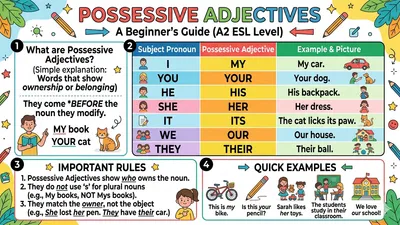
Whose is it?
Practice talking about ownership.

Conditionals & Wishes Mastery Speed Run
Master the tricky differences between first, second, and third conditionals, as well as present and past regrets using "wish" in this fast-paced B1-B2 grammar challenge.

M3 Unit 1 Review
A quiz to review unit 1 of Wide Angle 2.