
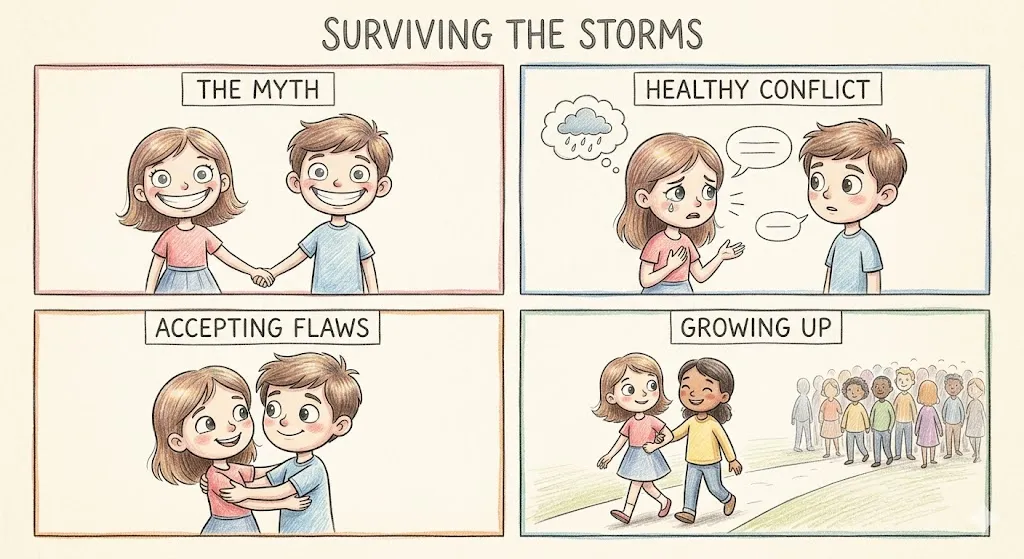
Surviving the Storms
Learn about handling conflict in friendships and why having a smaller group of friends is completely normal as you grow up.
Title
Surviving the StormsSeo_intro
Learn about handling conflict in friendships and why having a smaller group of friends is completely normal as you grow up.
Reading Text
There is a common myth that best friends never fight. In reality, a relationship without any disagreements is often a relationship where people are hiding their true feelings. Psychologists note that handling conflict well is actually a sign of a strong, healthy friendship. When you trust someone enough to say, "Hey, that hurt my feelings," and they listen instead of attacking you, your bond grows deeper. True friendship requires accepting that your friend is a different person with their own flaws, and they will occasionally mess up. Surviving a healthy argument proves that your friendship is stronger than a temporary disagreement. You might also notice your friend group shrinking as you get older. This is completely normal! As humans mature, our brains naturally undergo something called "socio-emotional selectivity." This is a fancy way of saying that we stop caring about being popular with everyone and start focusing our energy on a smaller, higher-quality circle of people who truly make us feel safe. So, if you find yourself drifting away from a large crowd to hang out with just one or two close friends, you aren't losing your social skills—you are just growing up.
Activities
Vocabulary
- Label: mythAnswer: v1
- Label: disagreementsAnswer: v2
- Label: conflictAnswer: v3
- Label: flawsAnswer: v4
- Label: matureAnswer: v5
- Text: a widely believed but false idea or story
- Text: arguments or situations where people have different opinions
- Text: active disagreement or fighting between people or groups
- Text: imperfections or weaknesses in someone's character
- Text: to become fully grown, developed, or adult
- Before: It is a commonAfter: that eating carrots gives you perfect vision.Answer: myth
- Before: Even the best teams haveAfter: about how to play the game.Answer: disagreements
- Before: Learning how to resolveAfter: is an important life skill.Answer: conflict
- Before: Nobody is perfect; we all have our ownAfter: .Answer: flaws
- Before: As puppiesAfter: into adult dogs, they usually become calmer.Answer: mature
Comprehension
- Text: Best friends who never fight have the strongest relationships.Answer: false
- Text: Handling conflict well shows that a friendship is healthy.Answer: true
- Text: True friends expect each other to be perfect without any flaws.Answer: false
- Text: It is normal for your friend group to get smaller as you get older.Answer: true
- Text: Drifting away from a large crowd means you are losing your social skills.Answer: false
- Text: friends / huge / best / that / myth / a / There / is / never / fightAnswer: There is a huge myth that best friends never fight.
- Text: healthy / handling / a / of / sign / a / friendship / is / conflictAnswer: Handling conflict is a sign of a healthy friendship.
- Text: your / their / own / friend / has / flawsAnswer: Your friend has their own flaws.
- Text: older / your / shrinking / friend / group / you / get / as / noticeAnswer: Notice your friend group shrinking as you get older.
- Text: just / losing / social / skills / are / up / growing / you / notAnswer: You are not losing social skills just growing up.
Written Expression
- Text: Describe a time you had a disagreement with a friend. How did you fix it?
- Text: Do you prefer having a large group of friends or a few close friends? Why?
My friend and I had a disagreement about what movie to watch. We fixed it by taking turns choosing the movie.
I prefer having a few close friends because I feel more comfortable sharing my true feelings with them.
Critical Thinking
- Why do you think people often try to hide their true feelings to avoid disagreements?
Explain the concept of 'socio-emotional selectivity' in your own words. Why does our brain do this as we mature?
References
Recommended for You
Small Steps, Big Changes: The Science of Good Habits
A B1-level ESL reading passage and worksheet based on 'Atomic Habits', designed to teach high school students how small ...
Pip the Peaceful Panther
An A2 English reading comprehension worksheet about Pip the panther, managing big feelings, and mindfulness in the jungl...
Theo, Thelma, and the Sloth
An A2 English reading comprehension worksheet about Theo, a thirsty thief, featuring activities focused on target vocabu...