
The Science of Making Friends
Learn about the science of proximity and Aristotle's three types of friendships in this B1 English reading passage.
Title
The Science of Making FriendsSeo_intro
Learn about the science of proximity and Aristotle's three types of friendships in this B1 English reading passage.
Reading Text
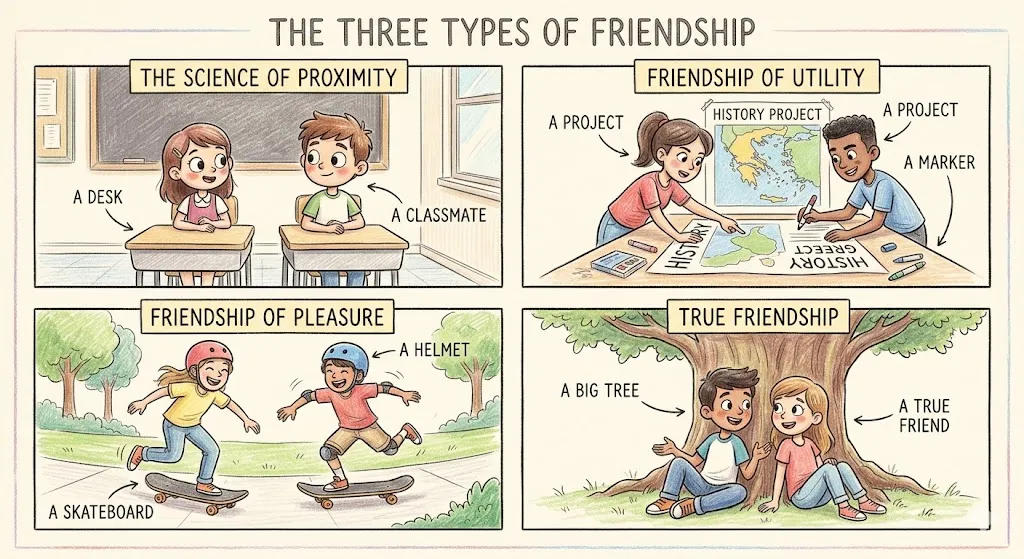
Have you ever wondered why you are friends with the specific people in your group? Often, the answer comes down to a simple scientific concept called proximity. Proximity means being physically close to someone. Research shows that we are highly likely to become friends with people who are near us. For example, you might become friends with the person assigned to sit next to you in science class, or a teammate in your sports club. During our teenage years, school acts like a giant laboratory for relationships. It mixes different people together every day and gives us the time to bond and connect. However, if you think about it, not all friendships are exactly the same. Over two thousand years ago, a famous ancient Greek philosopher named Aristotle thought about this, too. He divided friendships into three distinct categories. Interestingly, his ideas still make perfect sense in our modern world today. The first category is Friendships of Utility. These are convenient friendships based on usefulness. Think of the classmate you talk to only because you are partners on a big history project. You help each other achieve a goal, but you might not hang out outside of school. The second category is Friendships of Pleasure. These relationships are based on shared activities and having fun together. This might be your weekend gaming buddy, or the friend you only see at skateboard practice. You enjoy each other's company while doing a specific hobby, but the connection might fade if the activity stops. The third and most important category is True Friendships. This is the deepest and most meaningful level. You do not just hang out because it is convenient or fun. Instead, you deeply value each other for who you are as individuals. These friends offer a safe and protected space where you can be your weird, unfiltered self without any fear of judgment. You trust them with your secrets and your true feelings. While it is perfectly fine and great to have utility and pleasure friends in your life, true friends are incredibly special. They are the ones who support our physical and mental well-being in the long run. Building true friendships takes time, effort, and honesty, but the reward is a lifelong connection.
Activities
Vocabulary
- Label: wonderedAnswer: v1
- Label: proximityAnswer: v2
- Label: laboratoryAnswer: v3
- Label: philosopherAnswer: v4
- Label: distinctAnswer: v5
- Label: convenientAnswer: v6
- Label: fadeAnswer: v7
- Label: unfilteredAnswer: v8
- Label: judgmentAnswer: v9
- Label: well-beingAnswer: v10
- Text: thought about something with curiosity
- Text: the state of being physically close to someone or something
- Text: a room or building with equipment for scientific research (used here as a metaphor)
- Text: a person who seeks wisdom or enlightenment; a scholar of ideas
- Text: clearly different or separate from others
- Text: suitable for your purposes and needs and causing the least difficulty
- Text: to gradually disappear or lose importance
- Text: not changed or hidden; completely natural and honest
- Text: the act of forming a negative opinion about someone
- Text: the state of feeling healthy and happy
- Before: I have oftenAfter: how birds know where to fly in the winter.Answer: wondered
- Before: TheAfter: of the grocery store to our house makes shopping very easy.Answer: proximity
- Before: The scientists are testing the new medicine in theirAfter: .Answer: laboratory
- Before: Socrates was a famous ancient GreekAfter: .Answer: philosopher
- Before: There are threeAfter: types of bees in a hive.Answer: distinct
- Before: Taking the train is veryAfter: because it stops right next to my office.Answer: convenient
- Before: If you leave the shirt in the sun, the colors willAfter: .Answer: fade
- Before: She loved hearing hisAfter: opinions, even if they were a bit harsh.Answer: unfiltered
- Before: You can speak freely here without any fear ofAfter: .Answer: judgment
- Before: Sleeping eight hours a night is important for your mental and physicalAfter: .Answer: well-being
Comprehension
- Text: Proximity means being far away from someone.Answer: false
- Text: School acts like a laboratory because it mixes different people together.Answer: true
- Text: Aristotle divided friendships into five different categories.Answer: false
- Text: Friendships of pleasure are based on shared activities and hobbies.Answer: true
- Text: True friendships are based only on convenience and usefulness.Answer: false
- Text: are / highly / likely / We / to / friends / becomeAnswer: We are highly likely to become friends.
- Text: all / friendships / the / Not / are / sameAnswer: Not all friendships are the same.
- Text: divided / into / three / friendships / categories / AristotleAnswer: Aristotle divided friendships into three categories.
- Text: connection / fade / might / The / over / timeAnswer: The connection might fade over time.
- Text: true / friends / value / You / for / are / they / whoAnswer: You value true friends for who they are.
Written Expression
- Text: Describe a 'Friendship of Pleasure' that you have. What activity do you share?
- Text: Why do you think 'True Friendships' are the most important type? Explain your reasons.
A friendship of pleasure I have is with my friend Alex. We play basketball every Saturday at the park.
True friendships are the most important because they give you a safe space to be yourself and they support your mental health.
Critical Thinking
- How has the internet and social media changed the concept of 'proximity' in making friends?
Can a friendship of utility or pleasure eventually become a true friendship? Why or why not? Give an example.
References
Recommended for You

Small Steps, Big Changes: The Science of Good Habits
A B1-level ESL reading passage and worksheet based on 'Atomic Habits', designed to teach high school students how small ...
Pip the Peaceful Panther
An A2 English reading comprehension worksheet about Pip the panther, managing big feelings, and mindfulness in the jungl...
Theo, Thelma, and the Sloth
An A2 English reading comprehension worksheet about Theo, a thirsty thief, featuring activities focused on target vocabu...